
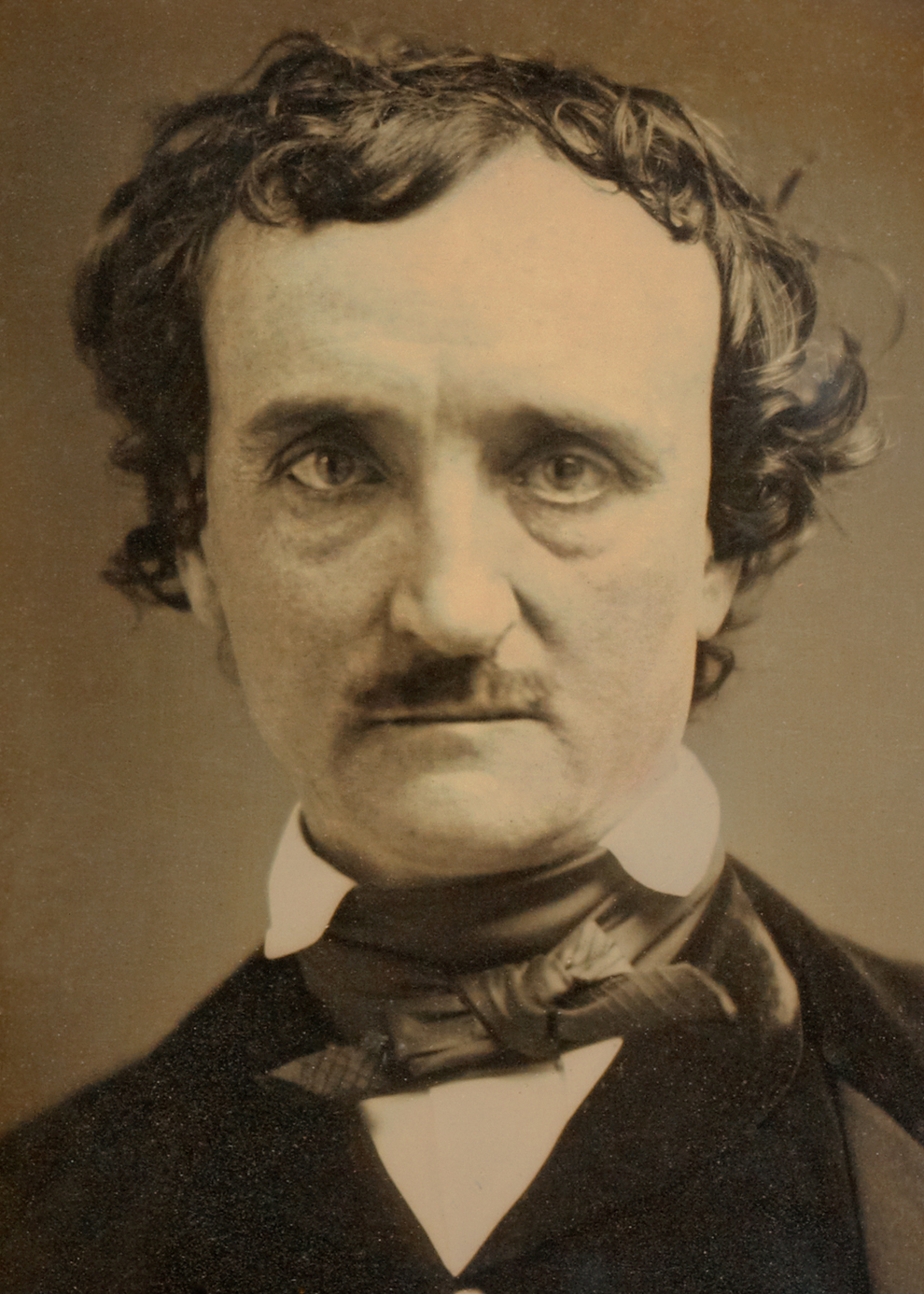
EDGAR ALLAN POE

(1809 - 1849)
BOOKS ::: AUTHOR ::: BOSTON 400
Edgar Allan Poe entered the world between performances. Born in Boston on January 19, 1809, near Boston Common, he was the son of Eliza and David Poe, working actors at the Federal Street Theatre. His mother played Cordelia in King Lear appeared among the singing peasants in The Brazen Mask; or, Alberto and Rosabella, a production combining mime, dance and music. On January 20, the day after Edgar’s birth, his father appeared in that same pantomime as Leczinsky. A baby arrived; the curtain rose. Before Poe made a living from terror, his family made theirs from the nightly manufacture of illusion.
By February 10, Eliza was back onstage as Rosamunda in Abaellino, the Great Bandit, with David playing Contarino. Edgar was barely three weeks old. His parents’ repertoire offered tragedy, disguise, persecution and death, but the danger at home was ordinary and immediate: earning enough to keep a family alive. His father disappeared from their lives; his mother died in 1811. Edgar was taken into the Richmond household of merchant John Allan, whose surname he acquired without ever being formally adopted. The theatre family scattered. Its youngest son would spend much of his life negotiating the distance between shelter and belonging.Poe turned that uncertain world into an exacting literary art. He helped shape modern psychological horror, pioneered the detective story and wrote poetry in which sound itself could become an instrument of obsession. In “The Raven,” grief acquires a voice that will not leave. In “The Tell-Tale Heart,” a murderer’s insistence on his own sanity becomes the evidence against him. In “The Murders in the Rue Morgue,” seemingly impossible violence yields to patient analysis. Poe gave us both the mind coming apart and the mind determined to put the pieces together.
His subjects were premature burial, decaying houses, lost women, compulsive love and the thin membrane between reason and madness. Yet the precision matters as much as the darkness. These were carefully constructed works by a writer who understood timing, repetition and the power of withholding an answer. The son of actors knew how to hold an audience. On the page, he could make a room contract around a reader until every sound seemed incriminating.
On October 3, 1849, Poe was found disoriented outside a Baltimore tavern. Four days later, he died at forty. The familiar gutter belongs to the legend; the surviving evidence does not establish it. Nor has the cause of his death been conclusively settled. A writer who made mysteries yield to detection left behind one that still resists it. The uncertainty became an invitation to speculation, turning his final days into another story told about him.
For Boston 400, Poe opens a doorway into the city’s working theatrical world: performers moving between towns, crowded bills, benefit nights and families surviving on applause that might never become adequate income. His birthplace belongs to that history as surely as his books belong to American literature. Poe also exposes the underside of American optimism - the anxiety beneath progress, the instability beneath respectability. He understood how readily confidence becomes delusion, how grief becomes obsession, and how a familiar room can become unbearable. The horror was already inside.