
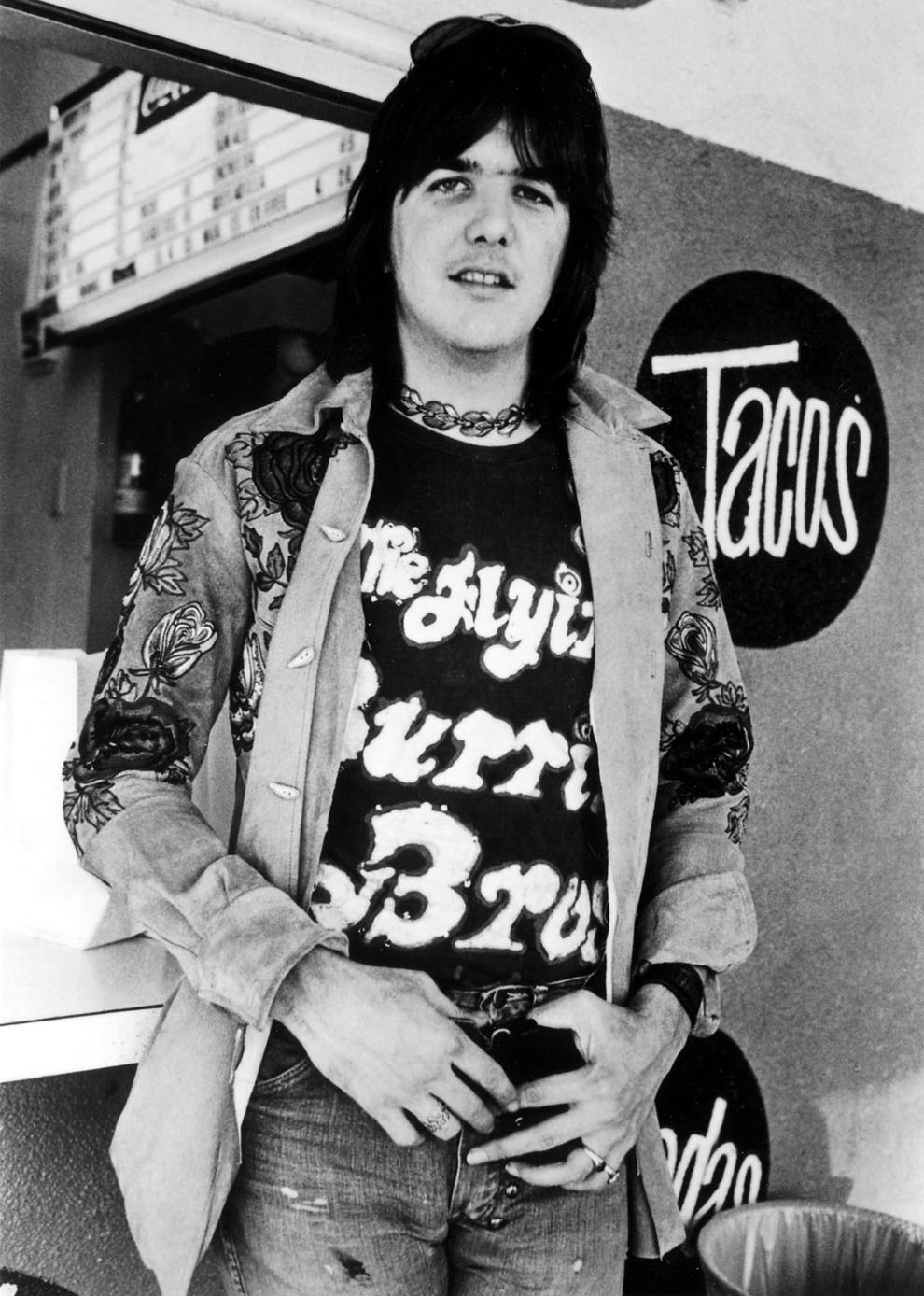
GRAM PARSONS

(1946 – 1973)
MUSIC ::: COUNTRY ::: GRAM. ::: BOSTON BABYLON :::
Gram Parsons was nine years old when Elvis Presley came to the City Auditorium in Waycross, Georgia, on February 22, 1956. The Louvin Brothers opened the show, carrying the ancient ache of country harmony; Elvis followed with “That’s All Right,” a blues song transformed into something the world had not yet learned to name. Gram later claimed that his father took him backstage and Elvis shook his hand. Whether the encounter lasted five seconds or grew larger in the retelling hardly matters. The next morning, Gram assembled the neighborhood children on the porch of the family home at 1600 Suwannee Drive and pretended he was Elvis. That porch was his first stage. The house would later be moved, turned toward another street and given another address—as if even the geography of Gram’s childhood were conspiring to disappear.
What followed was less a career than an education in American music. The Everly Brothers taught him how two voices could become a third; the Kingston Trio smuggled folk music into suburban living rooms; the Louvins, Buck Owens, Merle Haggard and George Jones led him deeper into country’s emotional machinery. Gram carried those lessons through the Shilos, Greenwich Village, Harvard, Boston and the International Submarine Band before walking into the Byrds and changing the direction of Sweetheart of the Rodeo. With the Flying Burrito Brothers, he dressed country music in rhinestones and carried Southern gospel, honky-tonk, soul and rock and roll onto the same stage. He called the result Cosmic American Music—not another genre, but a refusal to accept that these branches had ever belonged to separate trees. His final recordings with Emmylou Harris did not complete the idea. They released it into the world.
The easy version of Gram Parsons ends in Room 8 at the Joshua Tree Inn, followed by a stolen coffin and a fire in the desert. The real story keeps moving. It travels through Emmylou Harris, the Eagles, Firefall, the Rolling Stones, Uncle Tupelo, Wilco, First Aid Kit and every musician who discovered that the distance between country and rock was largely imaginary. In 2017, the Route 1 Project followed that music back to Waycross—to the surviving house, the vanished address, the tall pines, the church, the auditorium and the people who preserved the story before it disappeared. Joshua Tree tells us where Gram died. Waycross tells us where he learned to listen—and why, more than half a century later, America is still hearing what he heard.