Updated 2026
The Song Keeps Moving

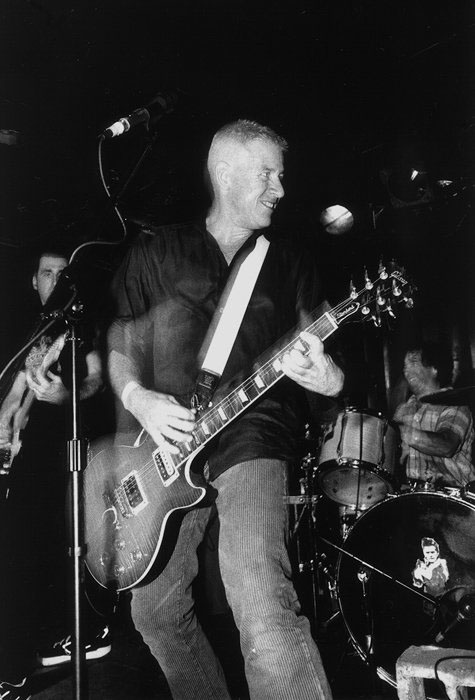
Rick Barton’s place in Boston music begins with The Outlets, the band he formed with his brother David Alex-Barton. The Outlets joined power-pop hooks to the force of the city’s punk underground, and Rick’s guitar helped give the band its physical edge. Their records and performances established a family line that would continue through several of Boston’s most consequential independent bands.
In 1996 Barton became a founding guitarist and songwriter in Dropkick Murphys. He played on Boys on the Docks, Do or Die, The Gang’s All Here and the Mob Mentality collaboration with The Business. His writing and rhythm guitar were fundamental to the early Dropkicks sound: street punk carrying older folk structures, working-class stories and choruses built to be shouted by a room.
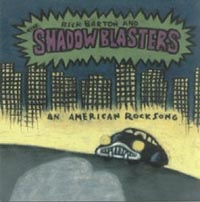
After leaving Dropkick Murphys, Barton turned inward for An American Rock Song. Recorded with the Shadow Blasters and released by One Way Productions, the album brought together his punk directness, roots-rock instincts and songs about damage, responsibility, endurance and repair. Billy Loosigian played lead guitar throughout; Paul Kochanski, Greg Burgess, James Gambino, Craig Macintyre and Joe Donnelly formed the larger circle around the recording.
Barton subsequently played with Everybody Out! and built Continental with his son Stephen Barton on bass. Continental returned him to touring and extended the same family transmission that began with The Outlets. He also worked as a producer, notably producing the Street Dogs’ self-titled 2010 album. Across these projects, Barton has treated Boston rock not as a sequence of former bands but as a living set of relationships carried from one lineup and generation to the next.
That circle has now brought Barton back together with original Dropkick Murphys singer Mike McColgan in Mike McColgan and the Bomb Squad. With Street Dogs and Bruisers guitarist Johnny Rioux, the Boston all-star group performs Do or Die in its entirety, returning the songs Barton and McColgan helped create to the stage. It is another form of restoration: the people responsible for the record reclaiming their own history as a live event.
The story remained active long after the original One Way page stopped. Continental released All a Man Can Do and Home on the Range, while Barton developed a later solo body of work with Rum Bar Records. His 2025 album The Great Unknown completed a solo trilogy and returned his songwriting to circulation more than two decades after An American Rock Song. The One Way archive now reconnects that present-tense work to the recording that captured an essential turning point in his career.