Updated 2026
Primal and Professional

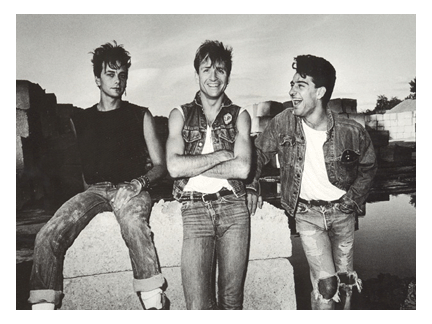
Shake the Faith formed in 1986 from the wreckage of two Boston bands that had appeared ready to break through. Guitarist, singer and songwriter Casey Lindstrom came from New Models, whose “Sight and Sound” had been produced by Ric Ocasek. Drummer Jesse Mayer came from Fingerpaint. Todd Erikson completed the trio on bass. What might have looked like a regrouping became its own identity almost immediately.
Within months Shake the Faith had released a debut 45, drawn heavy local airplay, entered WBCN’s Rock & Roll Rumble and established itself in Boston clubs. Carter Alan’s September 5, 1987 liner notes caught the essential contradiction: this was a power trio with roots in the 1960s, but without revivalism; a band surrounded by programmed pop and elaborate metal staging that relied instead on songs, volume and the chemistry of three players in a room.
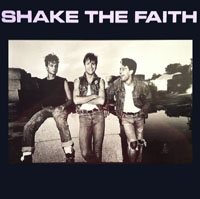
Phil Greene produced the self-titled seven-song record at Normandy Sound. The release moved between power pop, punk and hard rock at a moment when those audiences were often treated as separate camps. Shake the Faith crossed that boundary naturally and won the 1987 Boston Music Award for Independent Rock. The band shared stages with The Replacements, Soul Asylum and Mother Love Bone, shortly before members of the latter formed Pearl Jam.
The first chapter did not become the whole story. One Way documented a second album, Revival, released March 18, 2000. Two decades later, Lindstrom, Mayer and Erikson reunited for Sean McNally’s Legends of Boston program at the Magic Room in Norwood on November 5, 2021. The reunion brought the band’s history into the physical landscape now developing as SONO: the South Norwood cultural district.
Jesse Mayer provides another route forward. His later performance for Live from the David Bieber Archives returned a member of Shake the Faith to a new multitrack archive, connecting the original One Way catalog to Motherlode’s continuing recording practice. The story is therefore not sealed in 1987: the record, the Channel footage, the Norwood reunion and the Archives session are separate surviving transmissions from the same band.