2000–2030
History while Boston is still deciding what the history means.
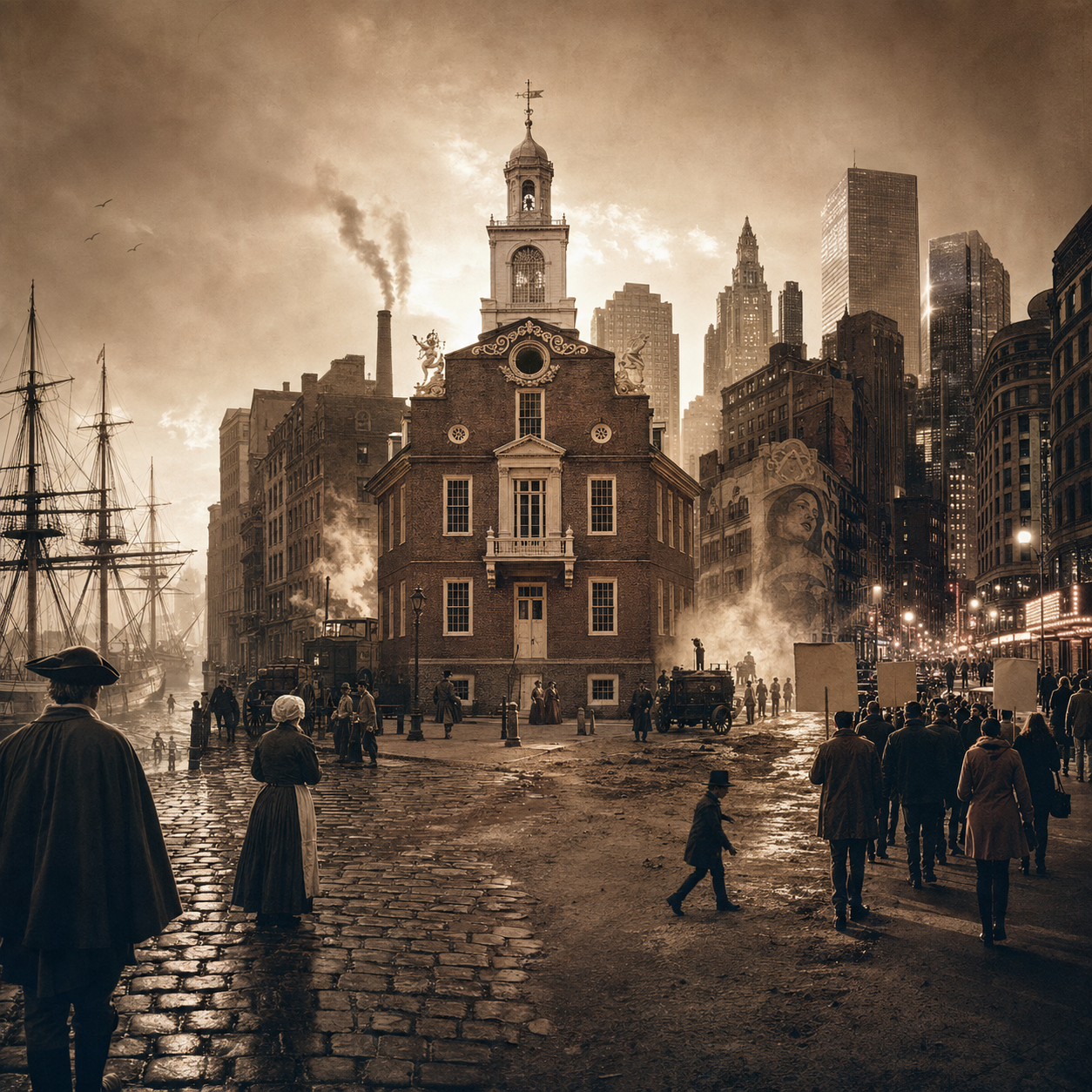
2000–2030 brings Boston 400 into living memory—a period when collapsing institutions, championship parades, technological reinvention, political firsts and public trauma rapidly become mythology. The evidence no longer survives only in official records. It lives in newspapers, broadcasts, photographs, websites, merchandise, protest signs, recordings and millions of objects preserved by the David Bieber Archives.
Here, the distance between an event and its cultural afterlife nearly disappears. The Catholic Church investigation becomes an Academy Award-winning film. A baseball championship becomes civic redemption. The closing of the Boston Phoenix turns a newspaper into an archive. The Marathon bombing produces both a citywide ritual of solidarity and a phrase—Boston Strong—that immediately enters popular culture.
This is history while Boston is still deciding what the history means.
2000–2009
SEPTEMBER 11, 2001 — Two hijacked airplanes depart from Logan Airport.
American Airlines Flight 11 and United Airlines Flight 175 leave Boston before being hijacked and flown into the World Trade Center. The attacks permanently transform airport security, public space, surveillance and Boston’s understanding of its place inside a global event.
JANUARY 6, 2002 — The Boston Globe begins publishing its investigation of clergy sexual abuse.
The Spotlight team documents abuse by Catholic priests and the institutional system that concealed it. The investigation alters Boston’s relationship with one of its most powerful institutions and becomes a global reckoning over journalism, authority and accountability.
THE CULTURAL AFTERLIFE: The investigation becomes the 2015 film Spotlight, demonstrating how local reporting can travel through popular culture and return as public memory.
NOVEMBER 18, 2003 — The Massachusetts Supreme Judicial Court issues its decision in Goodridge v. Department of Public Health.
The court rules that excluding same-sex couples from civil marriage violates the Massachusetts Constitution, placing the Commonwealth at the center of a national transformation in civil rights.
MAY 17, 2004 — Massachusetts begins issuing marriage licenses to same-sex couples.
Massachusetts becomes the first state in the nation where same-sex couples can legally marry. Boston and Provincetown become interconnected stages for a change that moves from courtroom argument into everyday life.
Motherlode connection: Provincetown, queer history, refuge, identity and the Provincetown 300 project.
OCTOBER 27, 2004 — The Boston Red Sox win the World Series.
The Red Sox defeat the St. Louis Cardinals to win their first championship since 1918. Eighty-six years of defeat, superstition, family memory and civic identity collapse into one collective celebration.
THE CULTURAL AFTERLIFE: The “Curse of the Bambino” demonstrates how sports history becomes folklore—and how folklore can become more powerful than the games themselves.
JULY 10, 2006 — A Big Dig tunnel ceiling collapses.
Concrete ceiling panels fall inside the Interstate 90 connector tunnel, killing Milena Del Valle. The disaster turns Boston’s enormous highway project into a confrontation over engineering, government oversight, public expense and accountability.
DECEMBER 31, 2007 — The Big Dig construction partnership formally ends.
After decades of planning and construction, Boston’s Central Artery/Tunnel Project reaches its administrative conclusion. The elevated highway has disappeared, the city has been physically reconnected and the cost of remaking Boston remains part of its political mythology.
JUNE 17, 2008 — The Boston Celtics win their seventeenth NBA championship.
The Celtics defeat the Los Angeles Lakers at Boston Garden, reviving one of professional basketball’s foundational rivalries and returning another inherited Boston identity to the civic stage.
2010–2019
SEPTEMBER 30, 2011 — Occupy Boston establishes an encampment in Dewey Square.
Demonstrators create a temporary community beside the financial district as part of the international Occupy movement. Public space again becomes Boston’s forum for arguments about wealth, power, inequality and democracy.
MARCH 2013 — The Boston Phoenix ceases publication.
After nearly half a century, The Boston Phoenix closes, ending one of the country’s most influential alternative newspapers. Its reporting, criticism, photography, advertisements and club listings preserve a cultural Boston that conventional newspapers often overlooked.
Motherlode connection: Boston music journalism, alternative newspapers, nightlife, the David Bieber Archives and Boston Babylon.
APRIL 15, 2013 — Bombs explode near the Boston Marathon finish line.
Two bombs kill three people and injure hundreds near Copley Square. The attack, ensuing manhunt and public response become one of the most intensely documented episodes in modern Boston history.
THE CULTURAL AFTERLIFE: “Boston Strong” moves almost immediately from an expression of solidarity into a civic slogan, graphic identity, commodity and permanent part of the city’s vocabulary.
OCTOBER 30, 2013 — The Red Sox win the World Series at Fenway Park.
In a season inseparable from the Marathon bombing, the Red Sox win a championship at home for the first time since 1918. Sport, mourning and civic recovery become intertwined.
JANUARY 6, 2014 — Martin J. Walsh becomes mayor of Boston.
Walsh succeeds Thomas Menino, ending a twenty-year mayoral administration and bringing a former labor leader from Dorchester into City Hall.
WINTER 2015 — Boston records its snowiest season.
Repeated storms bury streets, overwhelm public transportation and turn mountains of plowed snow into a defining image of the city. Weather once again becomes infrastructure, endurance, comedy and civic identity.
FEBRUARY 28, 2016 — Spotlight wins the Academy Award for Best Picture.
A film about the Boston Globe investigation wins Hollywood’s highest honor. Boston journalism returns to the city through cinema, transforming an institutional reckoning into internationally shared cultural memory.
AUGUST 19, 2017 — Thousands confront a “Free Speech Rally” on Boston Common.
One week after the white-supremacist violence in Charlottesville, a small rally is overwhelmed by a massive counterdemonstration. Boston Common resumes its historic role as a stage where the city argues publicly over identity, speech, racism and resistance.
JUNE 2019 — Wayfair employees walk out of the company’s Boston headquarters.
Employees protest the company’s sale of furniture intended for a migrant detention facility. The action demonstrates how labor protest has moved from the factory floor into the technology workplace.
2020–2026
MARCH 2020 — The COVID-19 pandemic closes Boston’s public life.
Schools, clubs, theatres, restaurants, offices and cultural institutions close as the city confronts a public-health emergency. Boston’s cultural life moves online while the pandemic exposes profound differences in health, employment, housing and access.
Motherlode connection: Streaming culture, disappearing venues, archival preservation and the struggle to maintain community without a shared room.
MAY 31, 2020 — Protesters gather in Boston following the murder of George Floyd.
Thousands march from Nubian Square to Boston Common as part of a national uprising against racism and police violence. The demonstration connects Boston’s contemporary streets to its much older history of abolition, protest and contested freedom.
MARCH 24, 2021 — Kim Janey becomes acting mayor of Boston.
Janey becomes the first woman and first Black person to lead the city, marking a historic break in Boston’s political leadership.
NOVEMBER 16, 2021 — Michelle Wu is sworn in as mayor.
Wu becomes the first woman and first person of color elected mayor of Boston. Her election reflects the demographic and political transformation of a city whose public identity had long been dominated by white ethnic political machines.
AUGUST 19, 2022 — The MBTA closes the Orange Line for thirty days.
The unprecedented shutdown attempts to address years of deferred maintenance and safety problems. Boston’s oldest continuing argument—whether its public infrastructure can keep pace with the city it serves—moves to the center of daily life.
JUNE 17, 2024 — The Boston Celtics win their eighteenth NBA championship.
The Celtics defeat the Dallas Mavericks and reclaim the record for the most championships in NBA history. A franchise built upon inherited mythology produces another generation’s civic memory.
2026 — Boston 400 begins assembling the evidence.
Four years before Boston’s four-hundredth anniversary, Motherlode.TV begins organizing the people, places, objects, events and cultural afterlives already living throughout its archive. The project does not wait for 2030 to manufacture a commemoration. It begins by discovering how much of Boston’s history is still active.
Motherlode connection: Boston Babylon, Boston For the Record, The Original History of Boston Rock & Roll, The Bostonians, the Motherlode World Atlas and more than two million objects from the David Bieber Archives.
The twenty-first century is still becoming evidence.