
THE T.A.M.I. SHOW
From Provincetown to the Front Lines of Rock & Roll
The Barbarians, Moulty, and the moment a Cape Cod band entered the picture.
MUSIC ::: PROVINCETOWN ::: PROVINCETOWN 300
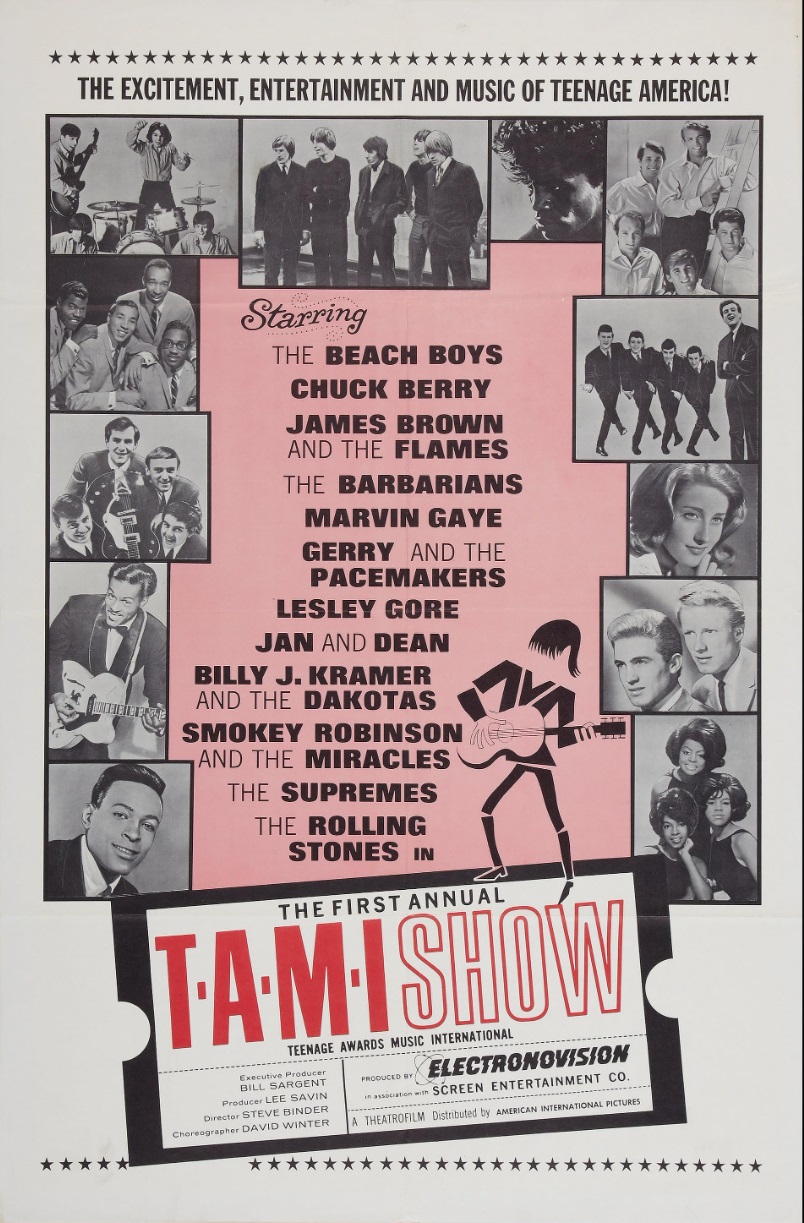
OCTOBER 29, 1964 — At the Santa Monica Civic Auditorium , cameras capture a remarkable gathering of rock & roll, soul, Motown and British Invasion performers. Among them are the Barbarians , a band that had come together in Provincetown only months earlier. Behind the drums sits Victor “Moulty” Moulton , playing with a prosthetic hook in place of his left hand.
The finished film would become famous for James Brown’s extraordinary performance and the Rolling Stones’ unenviable assignment of following him. But another story flashes through the picture: four musicians from the end of Cape Cod, suddenly sharing a stage with artists whose records had helped make that stage possible.
For a few minutes, Provincetown is in the room.
The Band Before the Movie
Before California, there was the Rumpus Room .
Guitarist Bruce Benson remembered working at Provincetown’s Howard Johnson’s during the summer of 1964. He handled the soda fountain; Moulty washed dishes. After work, they could play music at Victor’s Restaurant on Bradford Street. Benson had a mail-order Silvertone guitar and an amplifier that offered little distinction between quiet and loud. Moulty had drums, rhythm and plenty of hair.
The band took shape with Jerry Causi on bass and Ronnie Enos on guitar. The Rumpus Room, reached through an alley beside the Old Colony Tap, offered a stage, a dance floor and a chance. Soon the Barbarians were playing nightly and carrying their equipment through the streets to Surf Club matinees, making enough noise along the way to advertise themselves.
Benson’s recollection includes another distinctly Provincetown doorway: Walter Chrysler , whose museum hosted a performance that brought television cameras and newspaper attention. The musicians bought leather jackets for the occasion. Benson mistakenly thought Chrysler was paying.
These were the practical foundations of a rock & roll career: borrowed opportunities, inadequate equipment, summer jobs abandoned and expenses discovered too late.
A Hook, a Drumstick, a Different Future
Moulty had been a guitarist before the accident.
In a 2013 interview, he recalled growing up in Provincetown, playing guitar and experimenting with homemade explosives. At fourteen, an explosion cost him his left hand. He subsequently learned to play drums with his prosthesis.
His account of the Barbarians’ beginning was characteristically direct. A cousin asked whether he had a band. He said yes. He did not. Then came a Saturday-night booking and the urgent business of finding musicians.
The hook became part of the band’s unforgettable appearance, but it also represented a working solution to a devastating injury. Moulty had found a way to keep making music. Every beat depended on practice and an adaptation that worked.
Then the bookings grew. The musicians went to New York. By the end of October, they were in California.
A Bill That Crossed Boundaries
The T.A.M.I. Show placed musical traditions together that the record business often sorted into separate markets. Chuck Berry, the Miracles, Marvin Gaye, the Supremes and James Brown shared the program with the Beach Boys, Lesley Gore, Gerry and the Pacemakers, Billy J. Kramer and the Dakotas, and the Rolling Stones. Jan and Dean served as hosts.
Producer William Sargent envisioned a series of films whose proceeds would support music scholarships. Director Steve Binder used Electronovision , a television-based recording process intended for theatrical presentation. In his essay for the National Film Registry, historian David E. James identifies October 28 and 29 as the rehearsal period and October 29 as the day the finished film’s performances were recorded before invited high-school students.
The result preserves bodies in motion as well as songs: musicians watching one another, dancers filling the stage, teenagers answering the performers with screams. Released in 1964, it carried that encounter into movie theaters.
“We Were All There”
Moulty’s memories give the production a life beyond its running order. Asked about the film in 2013, he recalled a week spent around the other acts:
“We were all there, all the time. We hung around, played around…”
— Victor “Moulty” Moulton, A Bit Like You and Me , 2013
He described an audience-free performance followed by two crowded public shows. That recollection differs in detail from James’s production account; it should remain identifiable as Moulty’s memory, recorded almost fifty years later.
What comes through most clearly is his sense of proximity. The Stones were young musicians standing nearby. The Supremes were fellow performers. People now encountered through documentaries and greatest-hits collections were working in the same building.
He remembered the occasion as a transition between musical generations. His explanation could be sweeping, but the excitement was unmistakable: he had been present while the picture was being made.
One Song Was Enough
The Barbarians performed “Hey Little Bird.”
Their appearance was brief. They had no extensive hit catalog to bring with them and no long-established national reputation. In a program crowded with stars, they offered the sound and appearance of a new American band absorbing the moment and answering it.
That brevity now gives the footage a particular value. It catches them before the better-known “Are You a Boy or Are You a Girl?” and before the autobiographical “Moulty.” Ronnie Enos was still in the group; Geoffrey Morris would join afterward.
The film lets us see an early lineup in action rather than reconstruct it from sleeve notes. The instruments, hair, clothes and physical confidence belong to a specific moment. Moulty’s drumming is part of the performance, visible alongside the musicianship of everyone else on the bill.
A band can leave a large historical trace through a very small opening.
The Record That Came Later
The song “Moulty” followed in 1966 . It was not the number the Barbarians performed in T.A.M.I.
Built around the drummer’s account of overcoming the loss of his hand, the record made his personal history its subject. But its inspirational message came with a less uplifting business story.
In a 1992 Goldmine interview preserved by the Provincetown History Project, Moulty recalled resisting the original proposal, changing the words and recording the song. He also said the musicians did not want it released—and discovered that the label had issued it anyway when audiences began requesting it.
The disagreement helped drive their departure from Laurie Records. His recollection links the group’s subsequent difficulties to contractual obligations and recordings another label could not release.
The same business that could turn a musician’s life into a compelling record could also deprive him of control over when that story reached the public.
Provincetown in the Picture
The Barbarians belong in Provincetown’s cultural history beside its painters, writers, actors and experimental theater.
Their story begins with places people worked, drank, danced and made themselves heard. A restaurant after hours. A beachside club. A museum willing to host a rock band. Streets through which musicians carried their own equipment.
Those places helped produce the group that appears in The T.A.M.I. Show . Following that connection brings the celebrated California concert back to the local conditions that made one of its performances possible.
We remember the film’s giants. We should also remember the opening it gave four musicians from Cape Cod.
Moulty found a way to play. The Barbarians found a room. Then, for one song, they found themselves inside a film that would keep playing long after the room had emptied.