
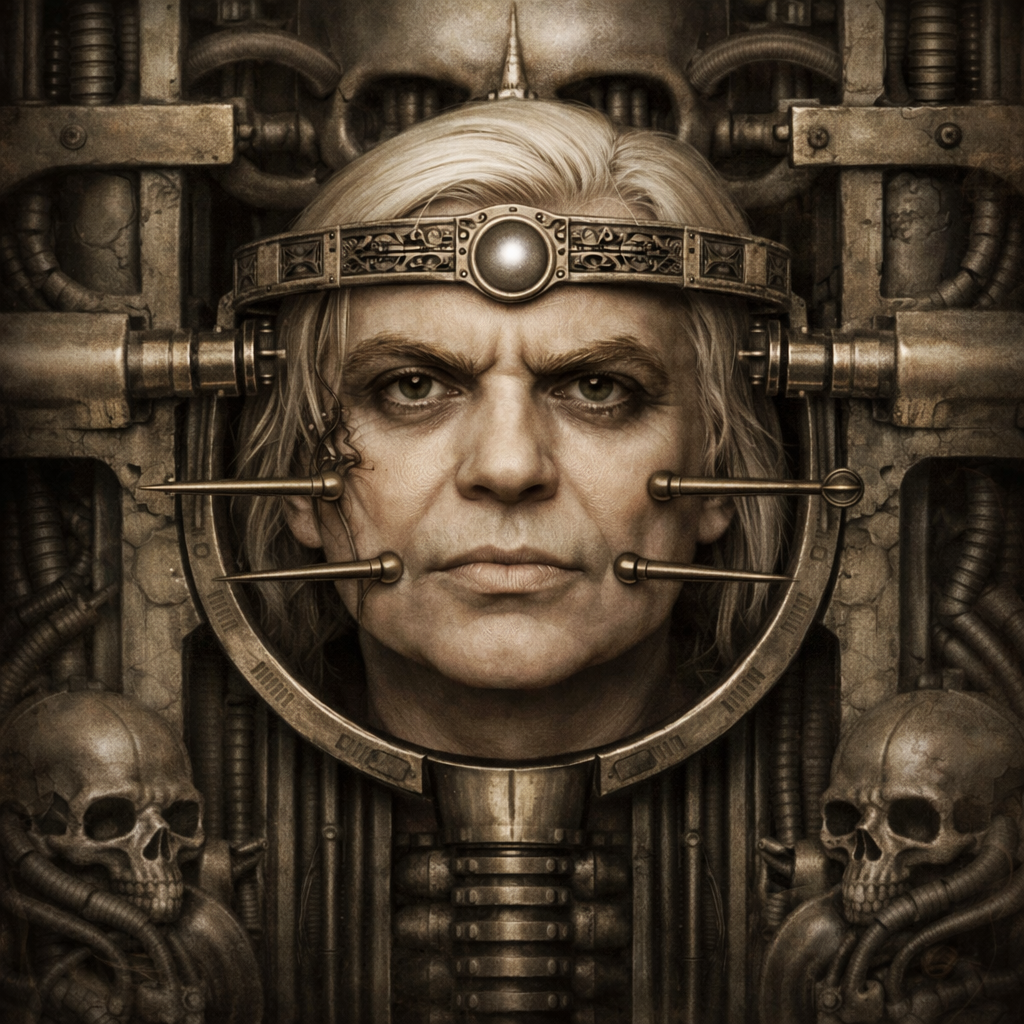
H.R. GIGER

(1940 – 2014)
ART ::: ILLUSTRATOR ::: SURREALIST :::
Hans Rudolf Giger emerged from the Alps like a transmission from the unconscious—cold, precise, and deeply eroticized. Raised amid medieval architecture, ossuaries, and Catholic dread, Giger absorbed death as texture rather than event. His early fascination with skulls, birth trauma, and machinery fused into a visual language where flesh and steel were indistinguishable, sex and terror inseparable. This wasn’t fantasy escapism; it was biomechanical realism—what the modern psyche actually looks like under pressure.
Giger’s work arrived at exactly the wrong time for polite culture and exactly the right time for truth. His airbrushed nightmares rejected the clean futurism of mid-century sci-fi in favor of a post-industrial womb where technology did not liberate humanity—it colonized it. With Necronomicon and later Alien (1979), Giger rewired horror by shifting fear from the monster to the process: implantation, penetration, reproduction without consent. He won an Academy Award, but the real achievement was cultural infection—once seen, his imagery couldn’t be unseen.
Giger belongs to the lineage of artists who didn’t decorate the future, but diagnosed it. Like Bosch, like Bacon, he treated the body as a site of collapse rather than beauty, insisting that progress leaves scars. In the Motherlode universe, Giger is a warning flare—proof that the subconscious keeps receipts, and that no amount of chrome, space travel, or digital sheen can outrun the ancient anxieties wired into our bones.