
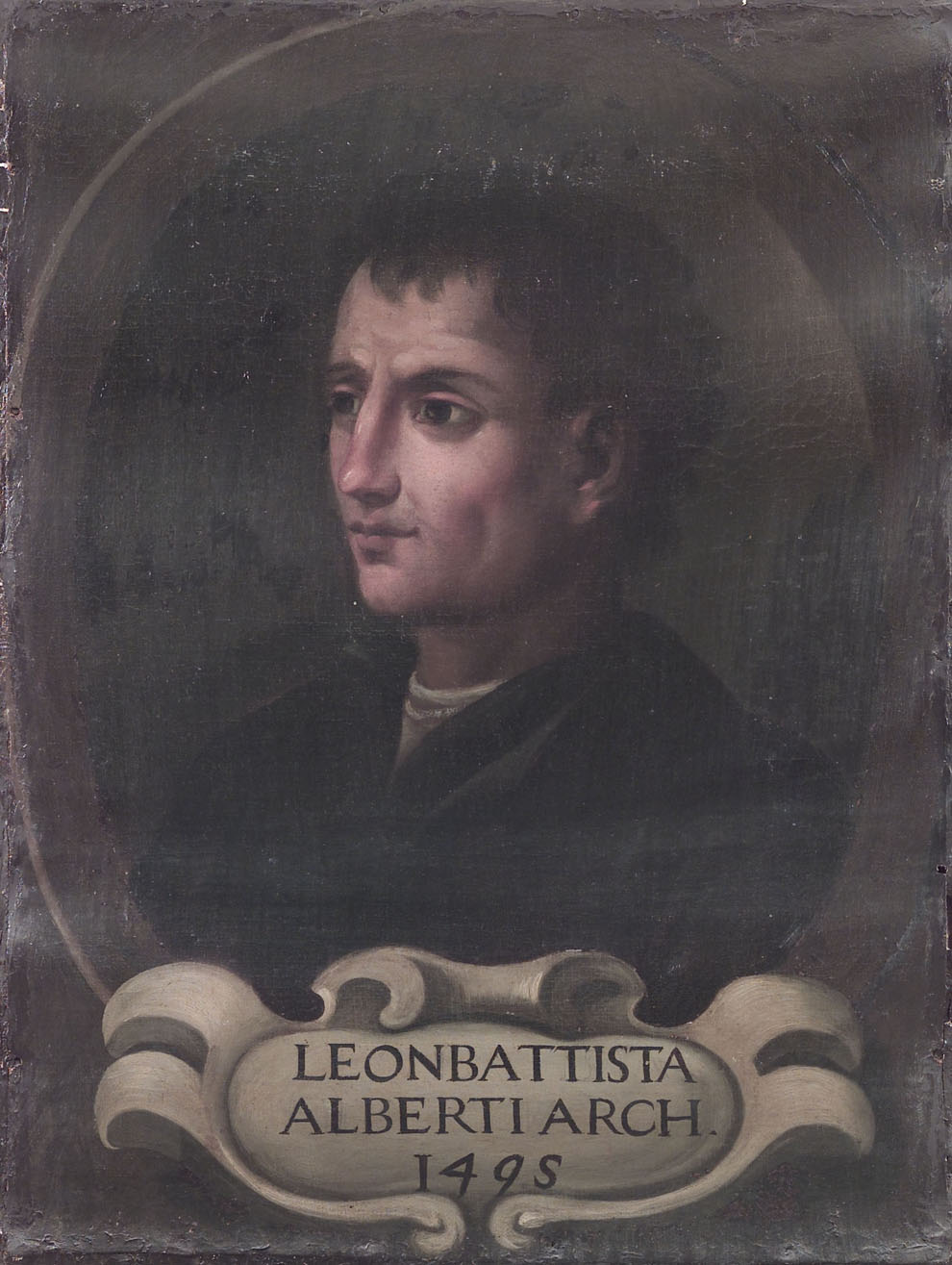
LEON BATTISTA ALBERTI
(1404 – 1472)
ART ::: RENAISSANCE :::
Leon Battista Alberti was not merely an architect — he was the mind that explained why the Renaissance could exist at all. Born into a Florentine family living in exile, he moved through courts, libraries, and humanist circles absorbing classical learning as if it were oxygen. He fenced, rode horses, wrote Latin prose and comedy, studied optics, mathematics, and cryptography, and believed the same laws governed the body, a painting, and a city. Beauty, to Alberti, was not taste but proportion: harmony measurable enough to be understood. Art was not decoration. It was knowledge made visible.
In De Pictura (1435), Alberti codified the new discovery of linear perspective — the idea that a painting could function as a window onto an ordered world. Brunelleschi had demonstrated it; Alberti explained it. Suddenly painters were no longer guild craftsmen but thinkers. A generation later, Piero della Francesca and Leonardo da Vinci would treat painting as investigation rather than imitation. His buildings carried the same logic: the façade of Santa Maria Novella in Florence and the Palazzo Rucellai translated ancient geometry into everyday urban life, while the Tempio Malatestiano in Rimini read less like a church than a philosophical argument carved in stone. Alberti didn’t paint the Renaissance; he taught Europe how to see.
Five centuries later, Bernard Berenson and dealer Joseph Duveen performed a different kind of architecture — cultural rather than physical. Acting as brokers to American industrial fortunes, they authenticated Botticellis, Bellinis, and Titians and moved them from fading European palaces into the homes and museums of Gilded Age collectors like Frick, Mellon, and Morgan. The Renaissance became portable, then reproducible: chromolithographs and devotional prints carried its Madonnas into ordinary living rooms, where sacred beauty turned into familiar wallpaper. What began in Florence as a philosophy of human perception became, in modern America, a language of status, faith, and aspiration — the Renaissance not lost, but mass-distributed..