Boston Revolts
Commerce, protest, print, performance and revolution transform a colonial port—and create names, places and acts of defiance that Boston will continue remixing for centuries.
The eighteenth century does not remain safely in the past. The Boston Tea Party becomes a rock club, revolutionary songs become the ancestors of protest music, public meetings become demonstrations and theatrical restrictions anticipate the city that will one day be “Banned in Boston.” These entries anchor the events in their own time while following their names, symbols and rebellious energy into Boston’s continuing cultural life.
JANUARY 17, 1706 — Benjamin Franklin is born on Milk Street.
Born in Boston, Franklin grows up in the city's printing and intellectual culture before becoming a printer, writer, scientist, diplomat and one of the defining figures of the American Enlightenment and Revolution.
1713 — The Boston Bread Riot.
Food shortages, high prices and merchants exporting grain bring more than two hundred angry Bostonians into the streets. During the confrontation, rioters attack the lieutenant governor’s property and he is wounded by gunfire. One of several bread riots during the period, the uprising demonstrates Boston’s recurring willingness to turn economic grievance into public protest.
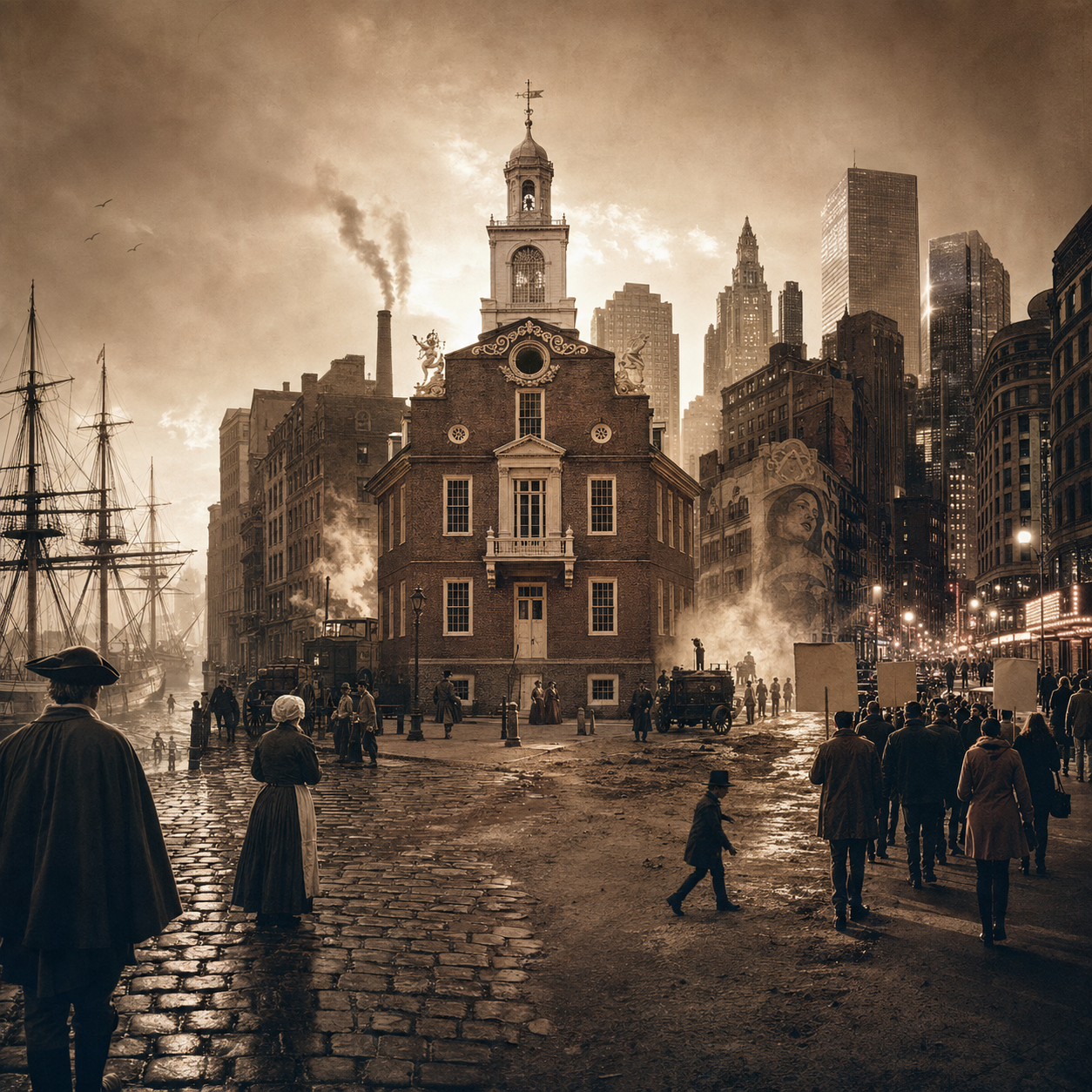
1713 — The Old State House is built.
Constructed as Boston's Town House, the building becomes the center of colonial government in Massachusetts. From its windows and doorstep, Bostonians will witness some of the defining confrontations of the coming Revolution.
SEPTEMBER 14, 1716 — Boston Light is first illuminated.
Built on Little Brewster Island at the entrance to Boston Harbor, Boston Light becomes the first lighthouse established in what is now the United States, guiding ships into one of colonial America's busiest ports.
1723 — Old North Church is built.
Christ Church in the City of Boston rises in the North End. Half a century later, lanterns displayed in its steeple will become inseparable from the story and mythology of the American Revolution.
1729 — Old South Meeting House is built.
The Puritan meetinghouse becomes one of Boston's most important gathering places, eventually serving as the stage for debates and mass meetings during the escalating confrontation with Great Britain.
1733 — Rebekah Chamblit is executed.
Chamblit, nearly twenty-seven years old, is convicted under a law that treats concealment of the birth of an illegitimate child later found dead as a capital felony. Her case exposes the severe legal and moral judgments imposed upon women, pregnancy outside marriage and reproductive secrecy in colonial New England
1735 — Massachusetts authorizes a Boston workhouse.
A provincial law permits Boston to establish an institution intended to confine, discipline and employ people classified as idle or indigent. The workhouse begins operating in 1738–39, separating its punitive regime from the town’s existing almshouse and beginning a long, complicated history of municipal responsibility for poverty and public welfare.
1737 — Boston's Irish community celebrates St. Patrick's Day.
The Charitable Irish Society marks St. Patrick's Day in Boston, establishing a tradition that will eventually become inseparable from the city's Irish-American identity.
LATE 1730s — Boston’s population reaches approximately 13,000.Boston has grown from a precarious Puritan settlement into one of the largest and most important commercial ports in British North America.
1742 — Faneuil Hall opens.
Merchant Peter Faneuil gives Boston a marketplace and public meeting hall, financed by a fortune deeply connected to Atlantic commerce and slavery. Commerce downstairs and political argument upstairs make the building an enduring—and complicated—symbol of Boston’s relationship among trade, assembly, freedom and exploitation
1747 — The Knowles Riot.
After Royal Navy press gangs seize local sailors for forced service, Bostonians riot and confront colonial authorities. The uprising foreshadows the resistance to British power that will define the city a generation later.
1754 — Concert Hall is built.
The Deblois family establishes a substantial gathering place on Hanover Street for concerts, assemblies, dinners and meetings. With a commercial shop below and a public room above, Concert Hall becomes an important early home for Boston’s developing secular musical and social life.
1756 — Central Burying Ground is established.
A new burial ground is created on Boston Common, eventually becoming the resting place of artists, musicians, soldiers and ordinary Bostonians from the eighteenth and nineteenth centuries.
MARCH 20, 1760 — The Great Boston Fire.
A devastating fire tears through Boston's commercial district, destroying hundreds of buildings and leaving much of the town's business center in ruins.
1765 — Boston resists the Stamp Act.
Opposition to British taxation erupts into demonstrations, intimidation and organized resistance. Boston moves rapidly toward the center of the growing colonial confrontation with Great Britain.
1768 — “The Liberty Song” is published.
John Dickinson’s words circulate through Boston newspapers and taverns, turning political resistance into something that can be sung, shared and remembered. Protest acquires a soundtrack.
MARCH 5, 1770 — The Boston Massacre.
British soldiers fire into a crowd on King Street, killing five people. Crispus Attucks is among the dead. Paul Revere’s influential engraving transforms the confrontation into revolutionary propaganda and demonstrates that controlling the image can help control the meaning of an event.
Motherlode connection: Crispus Attucks, Paul Revere, political graphics, protest and the manufacture of public memory.
DECEMBER 16, 1773 — The Boston Tea Party.
Colonists board three ships in Boston Harbor and dump hundreds of chests of East India Company tea into the water. Political protest becomes direct action and one of the defining events of the coming American Revolution.
APRIL 19, 1775 — The Siege of Boston begins.
Following the fighting at Lexington and Concord, colonial forces surround British-occupied Boston. The city and its neighboring communities become the opening battlefield of the American Revolution.
JUNE 17, 1775 — The Battle of Bunker Hill.
British troops capture the colonial position in Charlestown after repeated assaults but suffer enormous casualties, demonstrating that the rebellion will not be easily crushed.
MARCH 4, 1776 — The Continental Army fortifies Dorchester Heights.
George Washington's forces position artillery overlooking Boston and its harbor, making continued British occupation of the city increasingly untenable.
MARCH 17, 1776 — British forces evacuate Boston.
British troops and Loyalists leave the city by sea, ending the eleven-month Siege of Boston. The date will later be commemorated in Boston as Evacuation Day.
FEBRUARY 6, 1788 — Massachusetts ratifies the United States Constitution.
After contentious debate, Massachusetts becomes the sixth state to ratify the Constitution, helping secure the governmental framework of the new United States.
JANUARY 21, 1789 — The Power of Sympathy is printed in Boston.
Published anonymously and generally attributed to William Hill Brown, The Power of Sympathy: or, The Triumph of Nature Founded in Truth is widely regarded as the first American novel.
1789 — Massachusetts Magazine begins publication.
Boston's expanding print culture produces a magazine devoted to literature, history, politics, poetry and the cultural life of the young republic.
1792 — The Board Alley Theatre opens.
After failing to overturn Massachusetts’s prohibition against theatrical performance, the Boston Tontine Association opens a theatre in Board Alley and attempts to disguise its plays as “moral lectures.” When authorities close the illegal theatre on December 5, a disturbance erupts among members of the audience. Boston’s theatrical culture begins not with permission but with an act of cultural defiance.
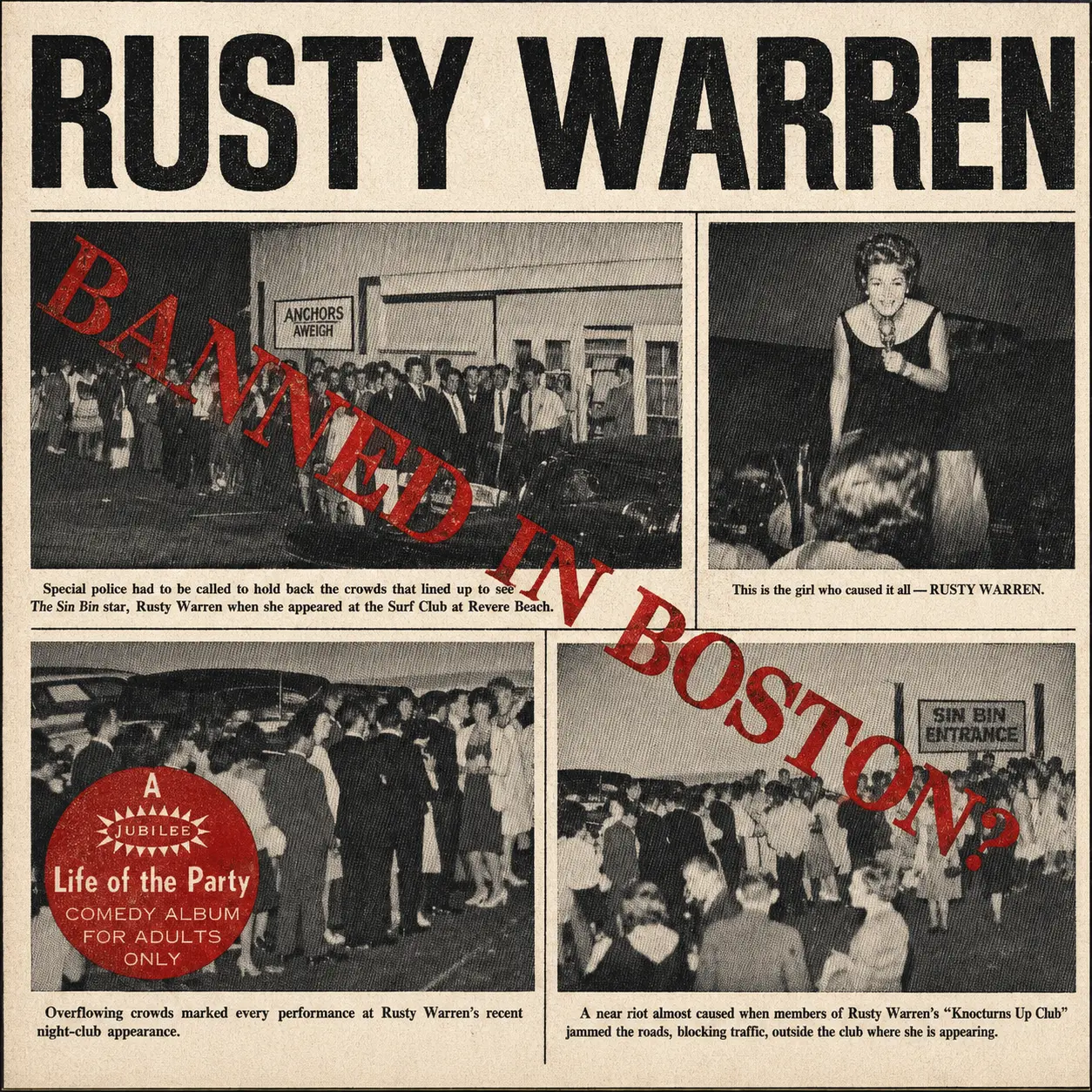
THE CULTURAL AFTERLIFE: Board Alley, Federal Street and Haymarket establish the contested beginnings of Boston theatre. Their struggle against inherited Puritan restrictions begins a much longer argument over performance, morality and censorship—an argument eventually summarized by one infamous phrase: Banned in Boston.
FEBRUARY 3, 1794 — The Federal Street Theatre opens.
Designed by Charles Bulfinch, the Boston Theatre on Federal Street gives the city its first substantial purpose-built playhouse. Its opening establishes professional theatre in a city that had recently treated dramatic performance as a crime.
DECEMBER 26, 1796 — The Haymarket Theatre opens.
A second major playhouse opens near Boston Common, competing with the more opulent Federal Street Theatre and appealing to the city’s growing middle-class audience. Boston’s entertainment landscape now contains not merely isolated performances but rival institutions, audiences and cultural politics.
1796 — The Boston Dispensary is established.
Created to provide medical treatment to Boston's poor, the dispensary becomes an important early experiment in organized community health care.
1796 — The Harrison Gray Otis House is built.
Architect Charles Bulfinch designs a Beacon Hill mansion for lawyer and politician Harrison Gray Otis, helping establish the Federal architectural style that will become one of Boston's most recognizable visual signatures.
OCTOBER 21, 1797 — USS Constitution is launched in Boston.
Built at Edmund Hartt's shipyard in the North End, the frigate later known as “Old Ironsides” begins one of the most celebrated careers in American naval history.
1798 — The Massachusetts State House is completed.
Designed by Charles Bulfinch and crowned by its distinctive dome, the new State House rises above Boston Common and establishes Beacon Hill as a center of Massachusetts political life.