
FEDERAL STREET THEATRE
February 3, 1794
BOSTON 400
BOSTON’S FIGHT FOR THE STAGE
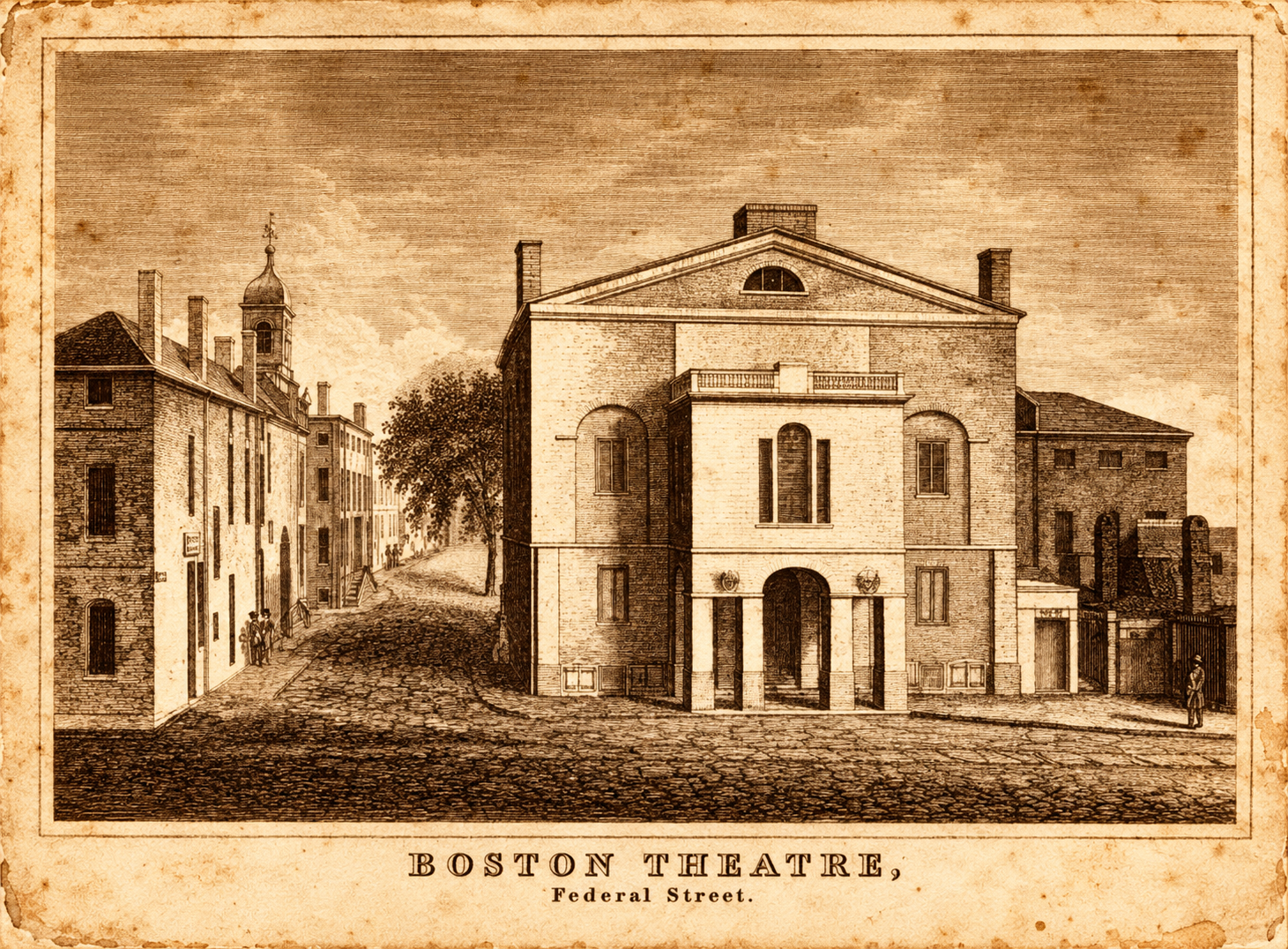
Before Boston could become a theatre town, it had to decide whether theatre belonged there at all. Massachusetts had banned theatrical entertainment in 1750, and when an unauthorized playhouse opened in Board Alley in 1792, Governor John Hancock sent the sheriff to shut it down. The audience rioted. Boston’s merchants pressed ahead, commissioning Charles Bulfinch to design a permanent home for the stage at Federal and Franklin streets . On February 3, 1794, the Federal Street Theatre , also known as the Boston Theatre , opened its doors. With approximately a thousand seats and decorations imported from England, it gave dramatic entertainment an imposing public address. In a city where the stage had been condemned as a threat to morality, taking a seat could itself express a conviction: imagination deserved room.
Among the performers who filled that room were two women whose family would leave an extraordinary mark on American literature. Elizabeth Arnold , newly arrived from England, made her American debut there in 1796 in Love in a Village . That April, her nine-year-old daughter stepped before the audience between acts of The Mysteries of the Castle and sang “The Market Lass.” The child became Eliza Poe , an actress, singer and dancer whose working life carried her along the eastern seaboard. She returned to Boston with her husband, David Poe , performing in the theatre rebuilt after the original burned in 1798. Their son Edgar was born on January 19, 1809, during their Boston engagement. Before Poe became a name associated with ravens, haunted houses and troubled minds, it belonged to a family earning its living under stage lights. The surviving notices preserve that earlier story: roles learned, songs sung, benefits advertised and a young mother returning to work after childbirth.
The Federal Street Theatre brought Boston’s public life onto the boards. An evening could mix drama, comedy, music and spectacle; in April 1813, the entire pit was reserved for the crew of USS Constitution , honored with a performance celebrating their victory over HMS Java . The building later became the Odeon , a lecture hall, before theatrical productions returned in 1846. Its walls are gone, but its papers survive at the Boston Public Library , recording the contracts, accounts and daily labor behind the applause. This was a place where Boston negotiated its appetite for pleasure, where national events became popular entertainment and where performers gave a suspicious city reasons to come back. Its finest legacy may be that persistent invitation: gather together, raise the curtain and see what another life can show you.
Follow the Connections
- Boston 400: Cultural Moments
- Performance, censorship and the city
- 1700s: the theatre opens
- 1800s: the Poe family and a public stage
- Edgar Allan Poe