
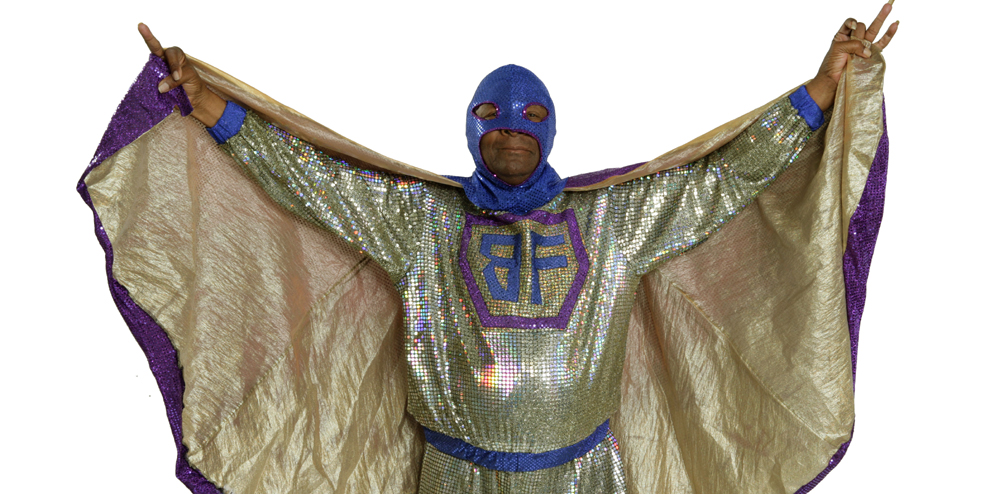
BLOWFLY

(1939–2016)
MUSIC ::: RHYTHM & BLUES ::: ROUTE 1 PROJECT :::
Blowfly entered the Motherlode through Miami. During the 2017 Route 1 Project, a stop at The Wolfsonian–FIU opened the door to Henry Stone, TK Records, the Miami Sound and the extraordinary double life of Clarence Reid. What first appeared to be the story of an outrageous masked novelty act quickly revealed something much larger: one of Miami’s most prolific songwriters, producers and musical connectors hiding behind a cape.
When mild-mannered soul singer Clarence Reid emerged in a sequined mask with a cape flowing behind him and a large BF across his chest, he was not preparing to fight crime. He was preparing to become Blowfly, the world’s filthiest musical superhero.
Most children have mangled the words to a favorite song and replaced the chorus with something dirty. Some adults never stop. Clarence Reid found a way to get paid for it.
Reid was born in rural central Georgia in 1939 and grew up working alongside his sharecropper family. He later said he left school as a child to work in the fields. While listening to country music on the radio, he began improvising obscene versions of popular songs to entertain the other workers. The adults sometimes paid him more for a few minutes of singing than he might otherwise earn through days of labor.
When his grandmother discovered where the money came from, she reportedly told him that he was a disgrace and no better than a blowfly—an insect that lays its eggs on dead things. The insult stayed with him. Years later, it became a name, a costume and an entirely separate musical identity.
When the mask came off, however, it revealed a very different story.
Reid arrived in South Florida during the early 1960s, when Motown and Stax ruled nationally but Miami was developing a musical language of its own. In Liberty City, he became part of the creative nucleus surrounding Willie Clarke, Johnny Pearsall and Deep City Records, Miami’s pioneering Black-owned soul label. The city was already a cultural crossroads. Southern rhythm and blues met music from Cuba, the Bahamas and Jamaica, while Liberty City and Overtown supported their own clubs, musicians, record shops and audiences.
The seeds of the Miami Sound had been planted, and Clarence Reid’s fingerprints were soon everywhere—as a singer, songwriter, arranger, producer and mentor.
Reid was an extraordinarily gifted soul vocalist in his own right. In 1969, his infectious single “Nobody But You Babe” reached No. 7 on Billboard’s R&B chart and crossed into the pop Top 40. Yet his greatest success came behind the scenes. He wrote or arranged hundreds of songs and became one of the most prolific contributors to Miami’s soul, funk and early disco scene.
One of his most important discoveries was Betty Wright. Reid first heard her as a child singing inside Johnny’s Record Shop, which also served as Deep City’s headquarters. He helped bring her into the studio and later co-wrote and produced some of her defining records, including “Girls Can’t Do What the Guys Do” and the million-selling “Clean Up Woman.”
He also wrote and produced for Gwen McCrae, including the chart-topping “Rockin’ Chair,” and worked throughout the Henry Stone and Steve Alaimo network that became TK Records. Reid contributed songs, arrangements and guidance across the roster, working in the same orbit as George McCrae, Timmy Thomas, Little Beaver and KC & the Sunshine Band. His blend of Southern soul, funk and Caribbean rhythm became part of the foundation of what the world came to know as the Miami Sound.
Behind Miami’s independent labels stood the distributors, promoters and hustlers who could move a record beyond the neighborhood where it was made. Henry Stone became the most powerful of them. After the Deep City partnership fractured, Reid and several of its central figures moved deeper into Stone’s orbit. Clarence Reid became one of the indispensable creative engines inside Stone’s expanding family of labels.
The contradiction at the center of Reid’s career was almost impossible to reconcile. As Clarence Reid, he could write perceptive, empathetic songs from a woman’s point of view. As Blowfly, he produced some of the most gleefully obscene records ever pressed.
The two identities were not separate careers so much as opposite releases from the same imagination: Reid the disciplined craftsman working inside the Miami music business, and Blowfly the unregulated id who mocked that business and nearly every song it produced.
The Blowfly character had never entirely disappeared. Reid continued entertaining musicians with filthy rewrites of popular hits, and Henry Stone eventually encouraged him to record them. In 1971, The Weird World of Blowfly transformed those private performances into an underground party record, complete with simulated nightclub noise, audience responses and lewd reinterpretations of familiar soul songs.
The albums circulated beneath the counter in record shops and at house parties, where parents played them after the children had gone to bed. Later generations of musicians would discover them hidden in family record collections.
As the records became more popular, Reid protected his respectable songwriting career by placing Blowfly behind a mask. The cape, hood and superhero costume allowed Clarence Reid to stand beside Blowfly while pretending the two had never met.
Blowfly also began moving beyond parody. Reid incorporated rhythmic spoken storytelling into songs he described as “soul talking.” Recordings including “Shake Your Ass,” “Rap Dirty” and “Blowfly’s Rapp” occupied territory that would soon be recognized as hip-hop.
Claims about any single “first rap record” remain complicated, but Blowfly unquestionably entered the form early. His records drew together Southern radio patter, Black oral comedy, funk, parody, call-and-response and increasingly elaborate spoken narratives. His 1980 version of “Blowfly’s Rapp” presented a bizarre tale of a confrontation with the Ku Klux Klan over a stripped-down funk track, years before narrative rap became commonplace.
His influence traveled quietly through underground record collections. Snoop Dogg, Public Enemy, Too $hort, Kool Keith and other artists acknowledged Blowfly’s importance, while recordings connected to Clarence Reid were sampled by artists across hip-hop and popular music. Blowfly’s obscenity anticipated the controversy surrounding Miami’s 2 Live Crew, but Reid had been exploring that territory more than a decade earlier.
After TK Records collapsed, Reid continued recording. He worked with Pandisc, a label that became important to the development of Miami Bass, and adapted once again to electronic rhythms, drum machines and the changing language of dance music.
By the 1990s and 2000s, Blowfly was being rediscovered by punk musicians, underground collectors, hip-hop producers and cultural troublemakers who recognized him as one of their own. Jello Biafra’s Alternative Tentacles released Fahrenheit 69 and Blowfly’s Punk Rock Party, bringing Reid into clubs and punk venues far removed from the Miami soul world where he had begun.
It was not quite a comeback. It was cultural transmission: an artist passing from Black Southern soul to party records, rap, sampling, Miami Bass, punk rock and contemporary art without ever becoming fully respectable.
Despite his influence, Reid’s later years were financially difficult. He sold the rights to much of his catalog and continued touring well into his seventies. His final decades revealed one of the oldest stories in popular music: a creator whose work enriched generations of musicians while leaving the creator himself struggling to survive.
Clarence Reid died from liver cancer and organ failure in a South Florida hospice on January 17, 2016. He was 76.
The Route 1 Project arrived in Miami looking for one story and found an entire musical ecosystem. Blowfly was one of its strangest doors. Behind the cape stood Deep City, Liberty City, Overtown, Henry Stone, TK Records, Betty Wright, Gwen McCrae, Timmy Thomas, Little Beaver, KC & the Sunshine Band, Miami Bass, punk rock and hip-hop.
Clarence Reid did not merely live two musical lives. He became a transmission line between several worlds that popular history usually keeps apart.