
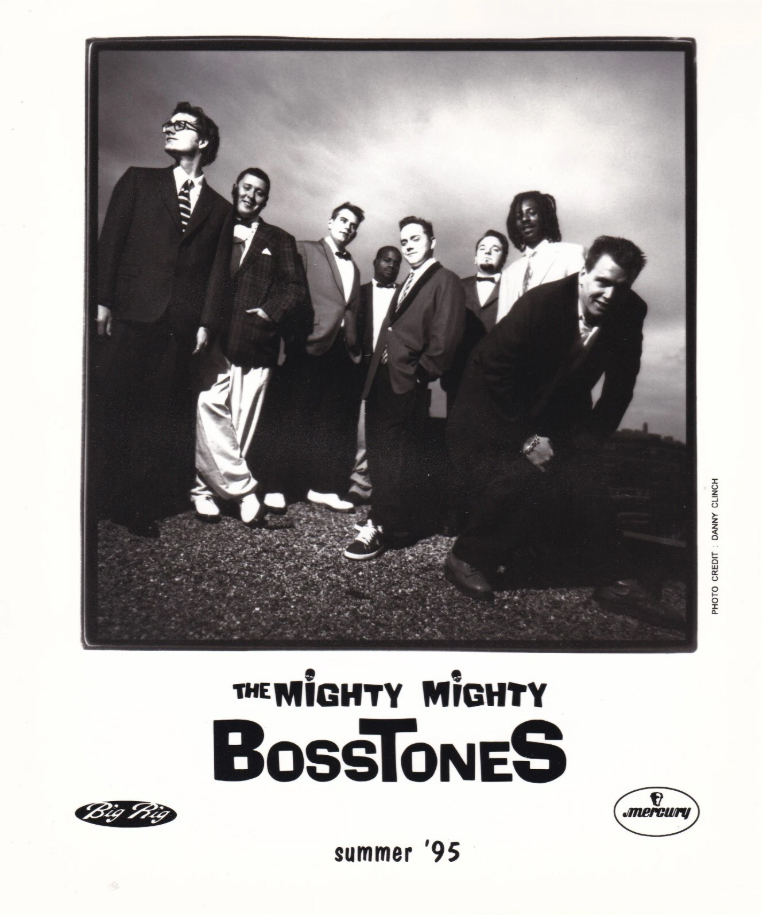
DICKY BARRETT
(1964 – )
MUSIC ::: MIGHTY MIGHTY BOSSTONES :: SONO
Dicky Barrett was born in Providence, but Norwood made him. His family arrived in 1968, and Barrett entered kindergarten the following year, beginning a hometown education that included Sunday Mass at St. Catherine of Siena, candlepin bowling and video games at the Norwood Sport Center, singing groups at Junior High North, and a disastrous turn as what he cheerfully calls the worst trombone player in the history of Norwood’s band program. At Norwood High, he was exceptionally bright, artistically restless and, according to his mother Pat, “a little bit of a hell-raiser.” He spent his time drawing, writing poetry and hanging around Father Mac’s. The crucial intervention came from David Powell, a teacher whose class Barrett never took. Powell heard that the difficult kid liked to write, sought him out and convinced him that his raw ability with words might become songwriting. Barrett’s first hardcore band, Impact Unit, even took its name from the Norwood Police Department’s riot truck. Norwood did not merely provide the setting for his childhood; it supplied the images, language, institutions and encouragement from which his creative identity was built.
At seventeen, Barrett became what he later called “the only suburban Norwood, Massachusetts rude boy.” An older kid introduced him and his neighborhood friends to British ska records by the Specials and the English Beat; seeing the English Beat open for the Pretenders in Boston completed the conversion. Ska’s buoyant Jamaican rhythms, working-class English style and sense of collective release collided in Barrett with the aggression of Boston hardcore. After Impact Unit and the Cheapskates came the Mighty Mighty Bosstones, a band so difficult for journalists to categorize that its members invented their own description: ska-core. From the Rat, the Channel, the Paradise, T.T. the Bear’s and the Middle East, the Bosstones carried their plaid-clad collision around the world, at their peak playing roughly 300 shows a year. Let’s Face It went platinum, “The Impression That I Get” topped the modern-rock chart, and Barrett’s gravelly voice eventually carried him from the front of the Bosstones to eighteen years introducing Jimmy Kimmel Live! Yet beneath the horns, suits, dancer and organized pandemonium remained the kid David Powell had encouraged to put words together.
Norwood never became a biographical footnote. Barrett returned whenever he could, stayed with lifelong friends, visited his mother and repeatedly carried his hometown into his public work. Archival footage of Norwood during the Blizzard of 1978 appeared in the Bosstones’ video for “2,000 Miles.” The Norwood High marching band later joined the group for a national promotional spot. Barrett has written affectionately about St. Catherine’s, the now-closed Sport Center, the Shamrock Pub, childhood Saturdays and the town that gave him room to become himself. “My job is in the West but my heart is in Massachusetts,” he once explained. Dicky Barrett may have become the gravelly voice of the most Boston of Boston bands, but before Norwood sent him into the world, it did something more important: it noticed him. A teacher encouraged the poet, a music scene welcomed the misfit, and an ordinary American town gave its only rude boy something worth carrying home.