
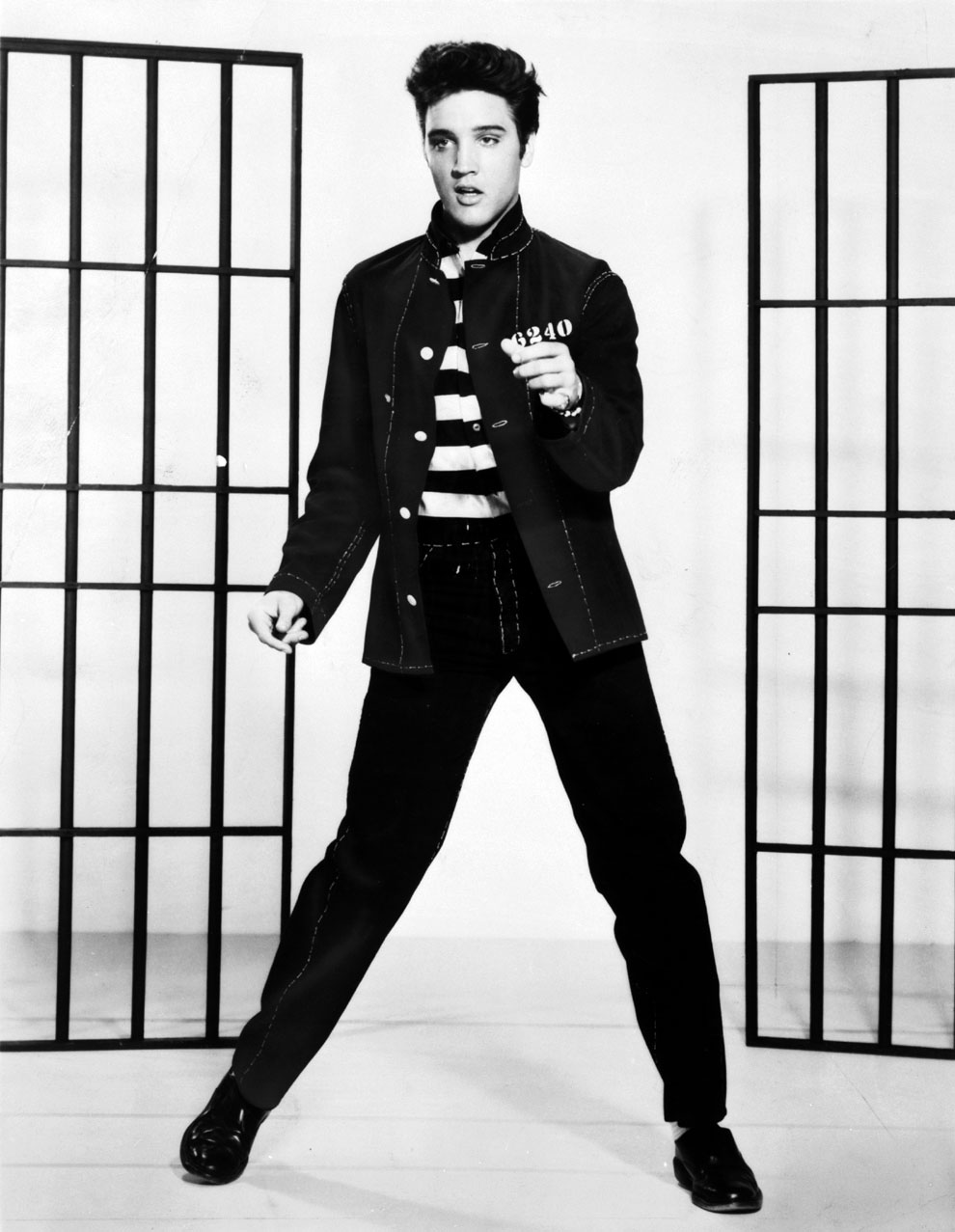
ELVIS PRESLEY

(1935 – 1977)
MUSIC ::: RHYTHM & BLUES ::: GRAM
The King of Rock & Roll.
Elvis Presley didn't simply launch rock and roll. On a summer evening in 1954, his recording of "That's All Right" shattered the invisible walls separating country, blues, gospel and rhythm & blues, proving that American music could be something larger than the sum of its traditions. Two years later, on February 22, 1956, one of the people forever changed by that revolution sat inside the Waycross City Auditorium in Georgia. Ten-year-old Gram Parsons watched Elvis perform, met him backstage after the show, and returned home believing that a life in music was possible. The following day, the front porch of the Parsons family home became his first stage.
That single performance became the first step in a remarkable journey. Gram Parsons grew from a Georgia boy imitating Elvis into the artist who coined the phrase Cosmic American Music, a vision that carried Elvis's musical revolution one generation further by uniting country, rock, folk, gospel and soul into a single American language. The road led from Waycross to Harvard University, Los Angeles, Nashville and beyond, crossing paths with The Byrds, The Rolling Stones and Emmylou Harris before coming full circle in the recording studio, where Parsons made the albums GP and Grievous Angel alongside James Burton, Glen D. Hardin and Ronnie Tutt—the legendary core of Elvis Presley's TCB Band.
Motherlode follows those connections. Elvis is not simply the King of Rock & Roll; he is the opening chapter in a larger American story that continues through Boston's 1960s folk revival, the birth of country rock, the Route 1 Project's return to Waycross, and an original theatrical production exploring the life and legacy of Gram Parsons. The story begins with "That's All Right." It ends with Cosmic American Music. Between those two moments lies one of the most remarkable journeys in the history of American music.