
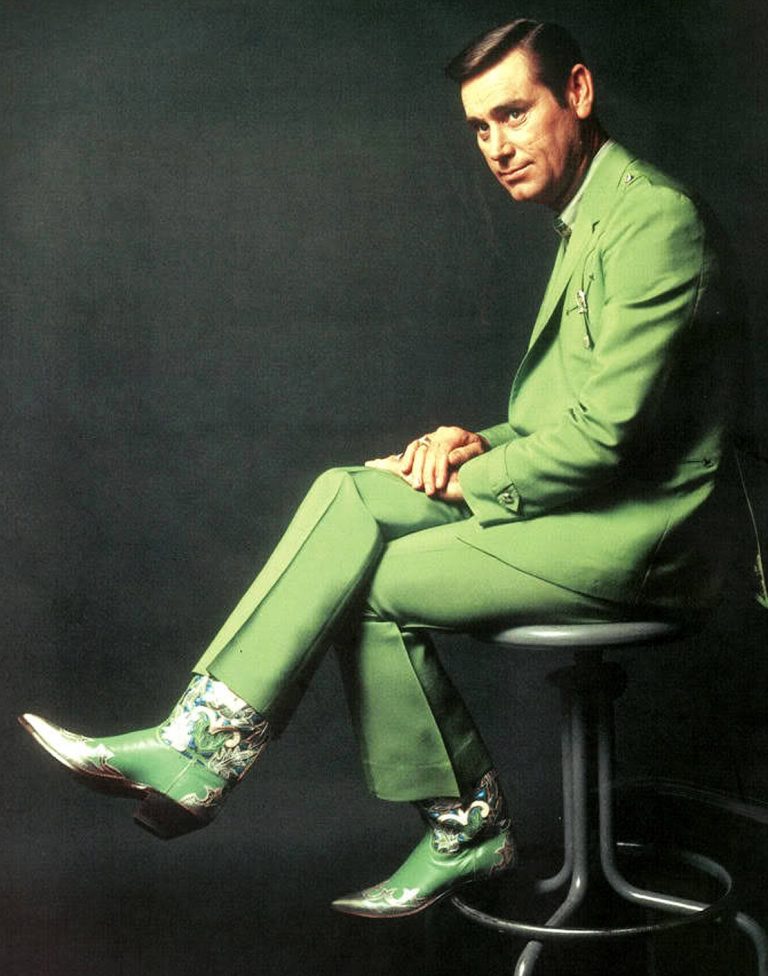
George Jones

(1931 - 2013)
MUSIC ::: COUNTRY ::: GRAM
George Jones made the human voice behave like no other instrument in country music. He could bend a single syllable through several notes, hesitate behind the beat and then recover the rhythm as though emotion itself had momentarily interrupted the song. His dramatic turns never sounded ornamental. Every crack, curl and descent carried information: denial giving way to recognition, bravado collapsing into grief, or a man attempting to conceal something his voice had already confessed. On recordings such as “She Thinks I Still Care,” “The Grand Tour,” “The Window Up Above” and “He Stopped Loving Her Today,” Jones did not merely communicate heartbreak. He recreated the instant when heartbreak becomes impossible to hide.
Jones’ genius was interpretation. He could take words written by someone else and make them feel autobiographical, locating emotional meanings that were not visible on the page. His turbulent life undoubtedly deepened the mythology surrounding him, but the legend of “No Show Jones” can obscure the astonishing discipline within the recordings. His phrasing was architectural. He understood exactly when to approach a note, when to delay it and when to let it fall apart. In duets—most famously with Tammy Wynette—his voice became part of an intimate dramatic exchange in which love, resentment, dependence and separation could occupy the same harmony. Country singing after George Jones was no longer simply a method of delivering a song. It was a form of emotional acting.
For Gram Parsons, Jones represented the deepest expressive possibility within country music. Here was proof that restraint could be more devastating than volume and that vulnerability could carry greater force than rebellion. Gram absorbed that lesson into “Hot Burrito No. 1,” “A Song for You,” “$1000 Wedding” and the wounded performances of GP and Grievous Angel. It became especially important in his partnership with Emmylou Harris, where two voices could reveal affection, distance and impending loss simultaneously. Gram did not attempt to sing like George Jones; he learned from Jones that a singer’s imperfections could become the most truthful part of a performance. Through Gram, generations of rock listeners followed that emotional trail back to the Possum—the singer who could make one bent syllable contain an entire ruined life.