
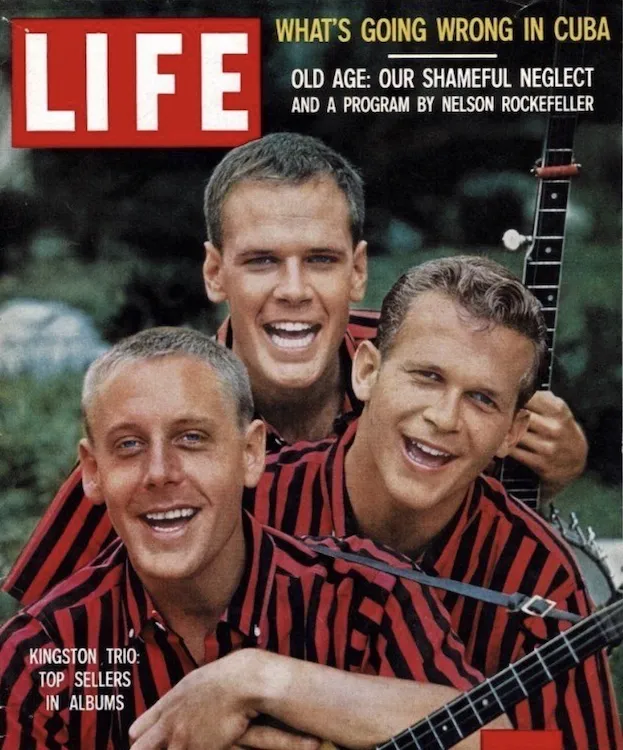
THE KINGSTON TRIO
(origin 1957)
MUSIC ::: FOLK ::: GRAM
By the end of the 1950s, The Kingston Trio had quietly transformed American music. Their polished harmonies, acoustic guitars and collegiate image brought the folk revival into the mainstream, years before Bob Dylan, Joan Baez and Peter, Paul & Mary emerged. At a time when folk singers were often stereotyped as beatniks and political outsiders, the Kingston Trio looked like clean-cut college students in striped shirts and crew cuts. Folk purists frequently dismissed them as a polished, commercial and overly vanilla version of the tradition, arguing that they had softened folk music's rough edges. Yet that accessibility proved to be their greatest strength. Beneath their wholesome image, the Trio introduced millions of Americans to traditional ballads, labor songs and the rich heritage of American roots music, becoming a Trojan horse that carried folk traditions into homes and communities the purists themselves rarely reached.
Among the countless teenagers captivated by their sound was Gram Parsons. Born into one of Florida's prominent citrus families, his future seemed tied to the prosperity and optimism represented by the Sunshine State's booming orange industry. Instead, he gravitated toward harmony singing and traditional folk music, forming The Shilos and performing throughout Florida before appearing at the state's exhibit during the 1964 New York World's Fair. That summer he took another step, playing regularly at Café Rafio on Bleecker Street in Greenwich Village, where the folk revival was already reshaping American music. The polished world he inherited was giving way to the musical world he chose.
One of the Trio's signature recordings, "M.T.A.," now feels almost prophetic. The song tells the story of Charlie, forever riding beneath the streets of Boston, years before Gram Parsons had ever seen the city. Yet Boston would become the place where everything changed. As a student at Harvard, Parsons discovered Hillbilly at Harvard, the late-night radio program that introduced him to Merle Haggard and redirected the course of his life. Long before Gram Parsons ever arrived in Cambridge, The Kingston Trio had already carried him there in song.