
Lawrence Strike: 1912

BREAD & ROSES

Mary Heaton Vorse, the Lawrence strike, and the right to a life worth living

A poem published in December. A strike that began in January. A journalist remembered in October. The story of Bread and Roses crosses the calendar because its central question never expires: what should working people expect from the wealth they create? Enough to survive another shift? Or enough time, security and freedom to participate in the world beyond the factory gates?

Mary Heaton Vorse would spend much of her life pursuing that question. Born in New York in October 1874 and raised in comfortable circumstances in Amherst, Massachusetts, she became a novelist, journalist and a vital presence in Provincetown’s cultural life. In 1912, she traveled to Lawrence to investigate a textile strike. What she encountered helped determine the work she would do for decades: make the lives of workers visible to readers who could afford to look away.

The phrase that eventually became inseparable from Lawrence had a history before the strike. During a 1910 suffrage campaign through Illinois, factory inspector and reformer Helen M. Todd described what political power could mean for working women. Bread represented the necessities: food, shelter and security. Roses represented music, books, education, nature—the pleasures and possibilities that poverty placed beyond reach. Todd published her account in The American Magazine in September 1911. That December, the magazine published James Oppenheim’s “Bread and Roses,” identifying its underlying phrase as a slogan of women in the West. The poem preceded the Lawrence walkout.

Todd and Vorse were connected through more than a shared interest in reform. Both belonged to A Club, a cooperative household of writers and settlement workers established at 3 Fifth Avenue in Greenwich Village in 1906. Todd financed the purchase of the house; Vorse entered through literary friendships. It brought together people who wanted to write, work and question the arrangements of American society. Years later, Vorse remembered the importance of living among people who challenged the system around them. The conversation about workers’ dignity had a home before it acquired a famous poem.

In Lawrence, dignity came at a measurable price. A Massachusetts law reduced the working week for women and children from fifty-six hours to fifty-four. The mills responded by cutting wages. For families already living close to hunger, even a small reduction could mean less food on the table. In January 1912, workers walked out. The strike spread across the city’s mills, drawing together thousands of immigrants divided by language, nationality and religion.

The Industrial Workers of the World, the IWW, helped organize that solidarity. Strike committees represented different language groups. Relief operations provided food. Workers marched, held meetings and found ways to sustain families through weeks without wages. Their demands included increased pay, double pay for overtime, an end to the bonus system and protection against retaliation for striking. Much of this work depended on women, whose labor continued in the kitchens, relief stations and organizing meetings as well as on the picket lines.

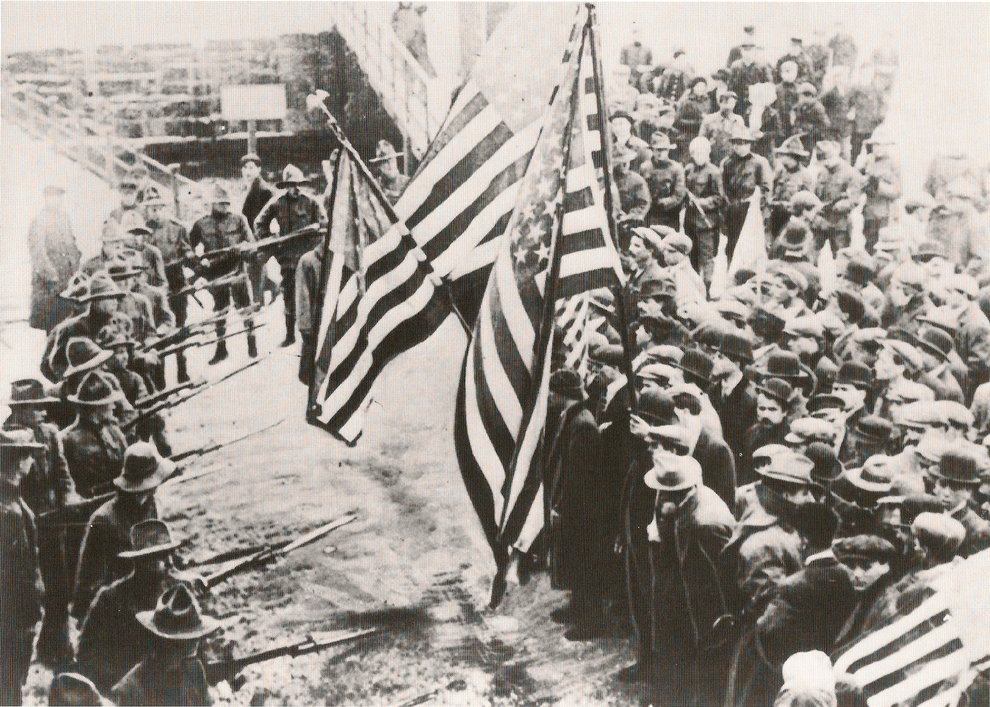
The authorities answered with police, militia and armed guards. Harvard students serving in the militia were among the forces deployed. The detail punctures any comfortable picture of the strike as a distant dispute between factory owners and anonymous laborers. Young men from one of the country’s most privileged universities stood within the armed machinery protecting industrial property. Vorse arrived to find soldiers guarding mills and ordering people through streets she had expected to recognize as familiar New England.

What sent her there was the treatment of the children. Strike supporters had arranged for workers’ children to stay with sympathetic families in other cities. Vorse and Joe O’Brien, whom she would soon marry, helped find homes for them in New York. When Lawrence authorities stopped a later group from leaving for Philadelphia, police violence against mothers and children provoked national outrage. Vorse secured an assignment from Harper’s Weekly and took the midnight train.

Her report, “The Trouble at Lawrence,” appeared on March 16, 1912. In her later recollection, she said it cost the magazine advertising from the American Woolen Company. The story exposed conditions that prosperous readers rarely had to see: overcrowded housing, exhausted families and children whose chances of survival depended on wages set far above their heads.

At Lawrence, Vorse also encountered Elizabeth Gurley Flynn, the young IWW organizer who became her friend. Flynn could give a meeting direction and emotional force. Vorse watched workers respond to her appeals, then join in singing. Her memoir remembers music throughout the strike: on picket lines, in soup kitchens, at relief stations and in meetings. Collective action gave people opportunities to speak, organize and discover abilities that the routine of the mill had scarcely allowed them to exercise.

This is where the famous name requires care. Generations have pictured Lawrence women carrying banners demanding bread and roses. The surviving evidence does not securely establish that familiar scene. In 1915, Upton Sinclair’s anthology The Cry for Justice attached Oppenheim’s poem to an account of young Lawrence strikers carrying such a banner. Later retellings helped make the association permanent. Historian Robert J. S. Ross, drawing on earlier scholarship, distinguishes the strength of the phrase from the uncertainty of the banner story. The name captures the struggle’s meaning; its supposed appearance on the streets in 1912 remains disputed.

We also have no explicit evidence that Oppenheim’s poem prompted Vorse to go to Lawrence. Her own account identifies the crackdown on the children as the immediate trigger. Vorse and Oppenheim belonged to overlapping literary and radical circles, but a shared community does not establish a particular act of inspiration. The documented story is powerful enough: she saw what happened, became angry and used her profession to make other people understand it.

That profession carried her between worlds. In 1915, Vorse helped make possible the first Provincetown Players productions; the group later used the fish house on her wharf, where Eugene O’Neill’s work reached the stage in 1916. Labor reporting and experimental theater both occupied her life. The workers she covered sought a greater say in their futures. The writers and performers around her sought room for experiences the established stage rarely admitted.

Oppenheim’s literary world touched that theater directly. His journal, The Seven Arts, published O’Neill’s short story “Tomorrow” in June 1917 and discussed the Provincetown Players that August. Vorse’s later labor investigations brought her together with Waldo Frank, Oppenheim’s associate at the journal. These connections reveal a community in which art and social criticism circulated through publications, friendships and practical work.

Decades later, Mimi Fariña carried the phrase into another form of service. In 1974, she founded Bread & Roses, bringing live performances to people isolated in institutions. Her musical setting of Oppenheim’s poem reached a wider audience through Judy Collins’s 1976 recording. The idea behind the name remained tangible: people needed nourishment, companionship and access to beauty. A concert could make that conviction audible.

For our October remembrance of Mary Heaton Vorse, this is the thread worth following—from a Greenwich Village household to the mills of Lawrence, from a Provincetown wharf to a song that outlived its makers. History has given the strike a name whose precise origins remain contested. The workers’ needs were unmistakable. Food, fair wages, safety, time with their children—and a chance to experience something beyond exhaustion.

Vorse made those lives part of the public record. Bread and roses names what was at stake: the right to have a life, and the means to live it.