
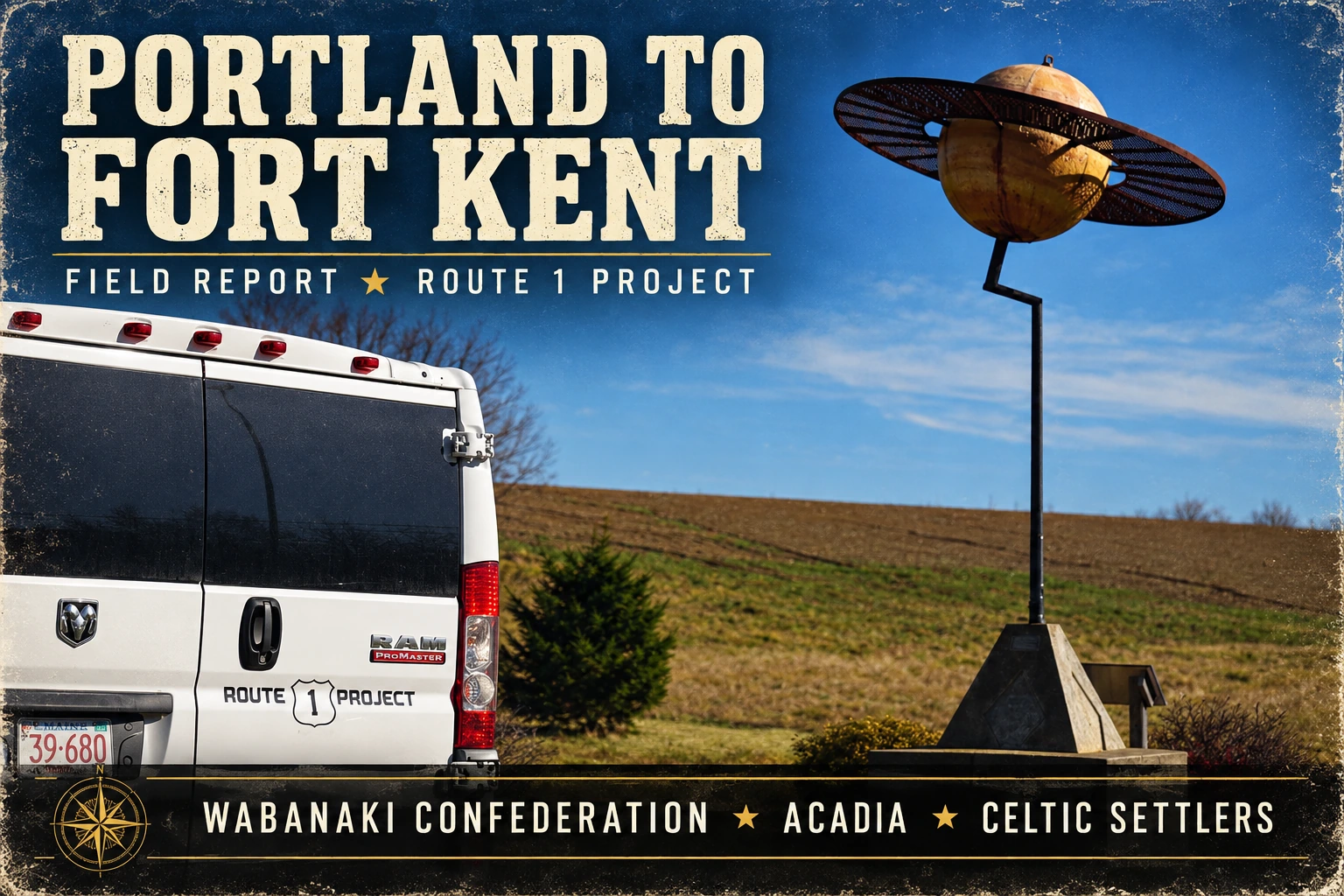
PORTLAND TO FORT KENT
By the time I reached Machias, I was running out of steam. The trip had given me more music, people and material than I could keep up with, and I thought the run to Fort Kent might amount to reaching the end of the road and taking the photograph. Instead, northern Maine turned the whole trip upside down. The connections I found there sent me back into the history of the music and gave me reasons to keep following leads when I thought I was nearly finished.
This report follows that northern stretch from Portland to Fort Kent, including the discoveries in Calais. Lura Jackson’s account below captures the moment: the Acadian connections, Tom MacDonald’s invitation to hear Barrule, and the introductions at the Wabanaki Cultural Center that led me to Petak Lola. Fort Kent has its own final report; this is the stretch of road that changed what reaching the end meant.
Northeastern Maine to Be Featured in Music Archives
By Lura Jackson
From the 2017 project files. The article is reproduced below as supplied; its references to forthcoming exhibitions, podcasts and an April 2018 unveiling describe plans at the time.
Since the 1920s when American youth embraced jazz music and its associated culture, social revolution has been mirrored time and time again by a revolution in the music industry. Such an occurrence is happening now as a result of a burgeoning movement of independent musicians, according to Chuck White, who, as part of the Route One Project, has been collecting recordings from musicians along the Eastern seaboard for the past few months. White described his recent arrival in Northeastern Maine and his subsequent realization of the musical connections of the region as “unbelievable” – a perception that will place the region front-and-center at an upcoming interactive musical exhibit in Boston that White is coordinating.
“My head is still spinning,” said White of his realizations as he was preparing to depart Calais to conclude his tour in Portsmouth, New Hampshire. “This was a huge discovery for me.”
While the history and music scene of Northern Maine was a surprise to White, he is not a newcomer to the music industry in any sense. Based in Boston, White booked bands to play in nightclubs for years, and he was a key player in promoting the grunge music movement. A trained musicologist, he wrote a twenty-article series on the history of New England music for a national magazine, he was also the archivist for Dick Clark’s National Music Foundation, and is the current Chief Archivist for the renowned David Bieber Archives, one of the largest music, pop culture and media collections in the country, actively assisting for decades with the amassing and cataloguing of the nearly 1,000,000-piece collection. In 2002, he saw the entire first season of American Idol behind the scenes in Santa Monica, California – an experience that led to his current work with the Route One Project.
“I was like, ‘this is karaoke,’” White recalls of the pop music show. “Meanwhile, all the bands like the ones I’ve found, they’re never going to leave Bristol or Virginia to go to L.A. – and the next Bob Dylan might never be found.” White felt strongly that rather than requiring aspiring singers to travel, someone needed to actively search out such bands to find “the people that are laughed at but did great things, like Picasso, and the people that slip through the cracks of history, those that are undiscovered, under-appreciated, but who resonate forever.” The idea led to him writing a proposal for a concept he called Searching For The Motherlode and sending it to a friend, but it would lie dormant for years before the friend responded with a suggestion of filming a pilot. Three years ago, White filmed the pilot in Portland, but those he had partnered with began to change the original idea too drastically, and he dropped out of the production before seeing it through.
The desire to find independent musicians remained strong for White, and earlier this year he was prepared to set off on his own from Key West to travel Route 1 North on a shoestring budget. Just before leaving Boston, Ernie Boch, Jr. and his Music Drives Us organization, who do great things for music appreciation and getting instruments into schools, connected with White and saw the previously filmed pilot. Being an avid supporter of music, Boch immediately agreed to fund the project and provide White with a van and any necessary equipment. The Route One Project, and its associated concept of Motherlode.tv, was soon fully underway.
Traveling on his own, White set a goal of spending a few nights in sixteen cities over eight weeks. Every night he would listen to and record local bands with high quality equipment, interviewing key figures in the music scene and filming footage for future usage. He obtained copious amounts of footage each night and worked late into the evening organizing the data before setting out again to travel or meet with musicians the next day. White has long been struck by the historical and cultural importance, value, and significance of John and Alan Lomax’s discovery and documentation of the music and spirit of America for the Library of Congress, which he also made a point to visit on his trip. And the Route One Project is as much an homage to their work, as it is to that of photographer Berenice Abbott, who, in 1954, journeyed along the length of U.S. Route 1, capturing the road, its towns, and inhabitants. Discovery is the essence of the Motherlode, of the Archives, and of the Route One Project, combined with the critical component of sharing those discoveries.
By the time White arrived in Machias, he knew he was at the near-conclusion of the tour. With his energy low from the long trip, he felt the final leg up to Fort Kent would be little more than symbolic. When he arrived, though, his mind was quickly changed. “It turned the whole trip upside down!” White exclaimed. Learning about the expulsion of the Acadians and their journey to become the Cajuns of Louisiana and the imposed subsequent immigration of the Celtic people to Northern Maine by the British thrilled him, only in part because one of his grandparents is from Ireland and the other is from Moncton. “They were here before the pilgrims. It’s the history of American music.”
While in Fort Kent, White received a call from Tom MacDonald, organizer of the Calais Celtic Concerts. MacDonald advised White that Barrule, a band from the Isle of Man, would be playing a concert in Calais. White readily agreed to come to Calais and soon found himself at the Wabanaki Cultural Center, which also houses the Maine Visitor Information Center. Vicki Farrell, manager of the visitor’s center, put him in touch with Petak Lola, and White learned of the first field recordings ever made of the Passamaquoddy Indians.
White likened the experience to when he began working the clubs in Boston. “I thought I knew everything about music, but when I went into the clubs I found out I didn’t know anything. Just like when I got here to Calais, I found out that I know nothing. I had thought ‘oh, there’s no reason for me to make that run from Machias to Fort Kent’ and it turned out to be the most important part of the project.” White considers his current tour to have been a reconnaissance run, and aims to return to Maine with a film crew in the future to spotlight independent musicians. This time, he said, he’ll be starting in Maine. “I’m just scratching the surface here. It was the biggest surprise of the whole trip.”
The recordings that White made while here will be integrated into an interactive music exhibit. Joe Spaulding, CEO of the Boch Center, will host the exhibit at their historic location in Boston’s Theater District, with an anticipated unveiling date of April, 2018. Prior to that, the recordings will be compiled into a podcast detailing White’s journey, and published on www.motherlode.tv.
Regarding the independent music scene in general, White said, “There’s a music revolution going on right now. I’ve only been excited like three times in my life, and I’m excited right now.” White cited the punk rock movement in the 1980s, the grunge movement in the 1990s, and the alt-country movement that emerged briefly in 2003 as the previous instances of when he felt that music was helping to channel the energy of the masses. “What’s neat is that it’s not any particular type of music,” White said, referring to how the internet has enabled a new way for all independent musicians to reach potential fans. “It’s happening everywhere… It feels like this is coming from a place where people are sick of corporate everything – corporate politics, the Kardashians, everything. It feels like there’s real people looking for truth. That’s where it’s all coming from.”