
CHAPTER FOURTEEN: MECCA, MOSAICS AND CHURCH BELLS
By the 1930s, Charles Crane had become difficult to describe with a single occupation. He was an industrial heir who preferred deserts to boardrooms, a diplomat without a permanent embassy and a collector more interested in what civilizations remembered than in what they manufactured.
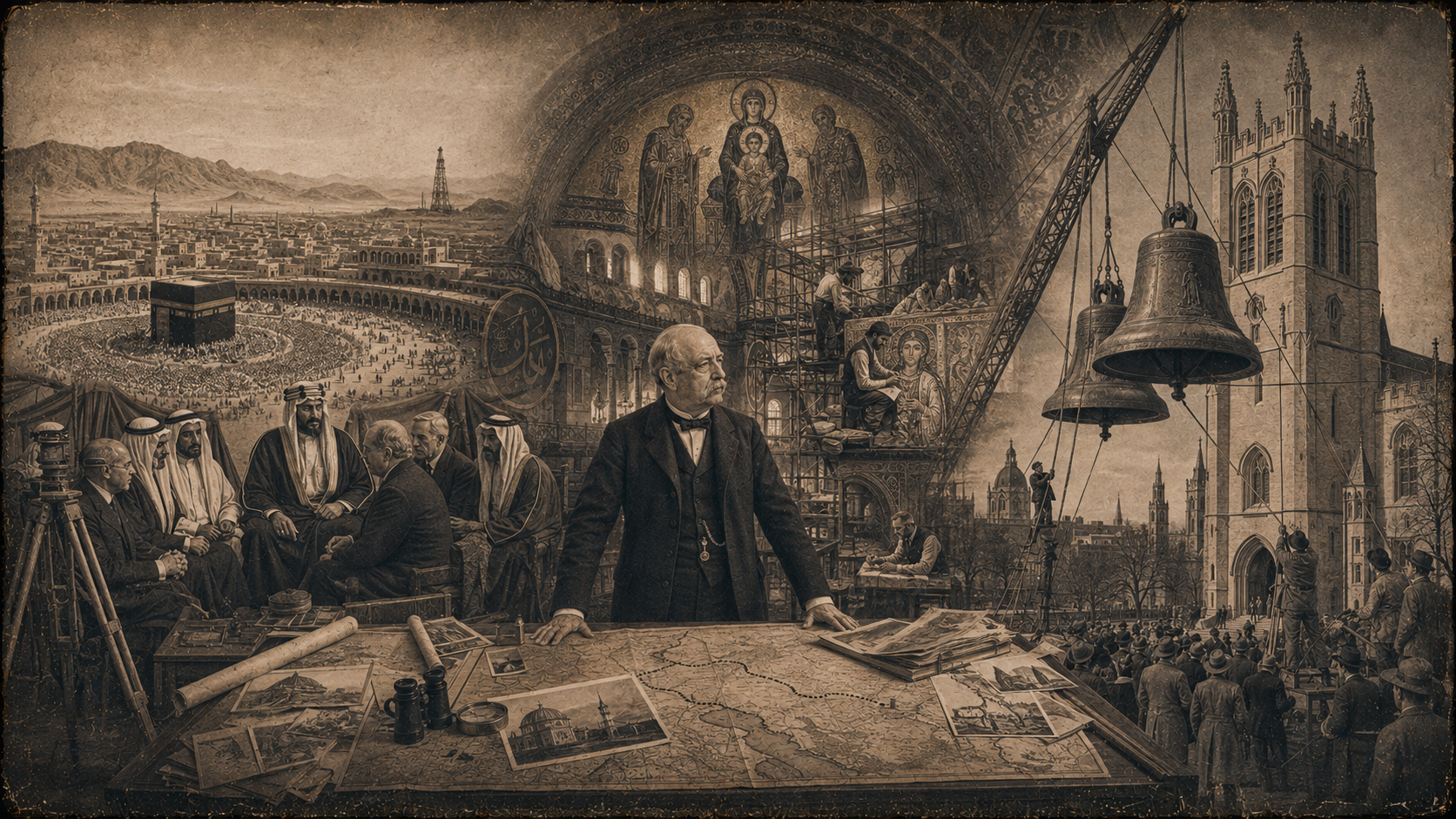
His travels now connected three seemingly unrelated worlds: the holy cities of Arabia, the buried mosaics of Constantinople and the silenced church bells of Soviet Russia.
The connection was preservation—but preservation with consequences no one could predict.
Crane’s involvement in the Arab world had begun with the King-Crane Commission. Although the Paris peace conference largely ignored its findings, Crane did not abandon the people the commission had interviewed. He continued traveling through the Middle East, meeting political and religious leaders and supporting projects intended to improve local agriculture, education and access to water.
In Yemen, Crane employed an American mining engineer named Karl Twitchell to search for water and mineral resources. The work attracted the attention of Abdulaziz Ibn Saud, the ruler who was uniting much of the Arabian Peninsula into the country that would become Saudi Arabia.
Ibn Saud faced a fundamental problem. The region surrounding Jeddah and the pilgrimage routes to Mecca needed reliable water. Crane traveled to Jeddah and offered the same practical solution his family had built its fortune providing elsewhere: find the water, move it and make settlement possible.
Crane could not enter Mecca as a non-Muslim, but the search he helped organize reached directly into the life of Islam’s holiest city. He sent Twitchell to survey the region for underground water and mineral deposits.
The engineer did not find enough water to solve the problem. He found indications of something else beneath the desert.
Crane had gone to Arabia looking for water. The trail led to oil.
Twitchell’s surveys helped draw American attention to the region’s petroleum potential. In 1933, Standard Oil of California secured a concession from Ibn Saud. Crane did not create the Saudi oil industry, but his curiosity, his engineer and his relationship with the king helped open the door through which it entered.
At the same time, another Crane-supported undertaking was looking beneath a different kind of surface.
Thomas Whittemore was an eccentric American scholar, archaeologist and humanitarian whom Crane had known through his Russian interests. In 1930, Whittemore founded the Byzantine Institute of America. With the permission of Mustafa Kemal Atatürk’s government, the Institute began uncovering and conserving the Byzantine mosaics hidden beneath plaster inside Hagia Sophia in Istanbul.
The building had begun as a Christian cathedral, become an imperial mosque after the Ottoman conquest and, in 1935, opened as a museum. Beneath its walls, Whittemore’s team uncovered faces that had been concealed for centuries—emperors, saints, the Virgin and Christ assembled from thousands of pieces of colored glass and gold.
Crane helped sustain Whittemore and the world surrounding the Byzantine Institute. Once again, his money was not building a monument bearing the Crane name. It was allowing an older civilization to become visible.
But Whittemore and Crane were also rescuing something that could not be revealed by removing plaster.
After the Russian Revolution, Stalin’s government attacked the Orthodox Church, closed monasteries and destroyed religious objects. Church bells were pulled from their towers and melted down. To the Soviet state, bells were surplus bronze. To Crane, they were the voice of a civilization.
In 1930, working through Whittemore, Crane purchased eighteen bells from Moscow’s Danilov Monastery before they could be destroyed. The largest weighed approximately thirteen tons. Crane donated the collection to Harvard, where a tower at Lowell House was redesigned to hold them.
For nearly eight decades, the bells of a Russian monastery rang over Cambridge, Massachusetts. In 2008, the originals finally returned to the restored Danilov Monastery and were replaced at Harvard by newly cast Russian bells.
Mecca, mosaics and church bells were not three separate Crane adventures. They were three versions of the same instinct.
Water sustained a sacred city. Conservation recovered sacred images. Rescue allowed a sacred sound to survive a government determined to silence it. Crane moved among Islam, Byzantine Christianity and Russian Orthodoxy without attempting to flatten them into one belief. He understood that civilizations expressed themselves through what they protected.
Yet preservation could not stop the political machinery moving across Europe. While Crane was rescuing the remains of fallen empires, Hitler was preparing to build a new one. Czechoslovakia stood directly in his path, and the German-speaking Sudetenland offered the excuse he needed.
The bells had escaped Stalin. The mosaics had escaped oblivion. Mucha and the country he helped imagine would not escape so easily.