CHAPTER FIVE: MEANWHILE, BACK IN WOODS HOLE
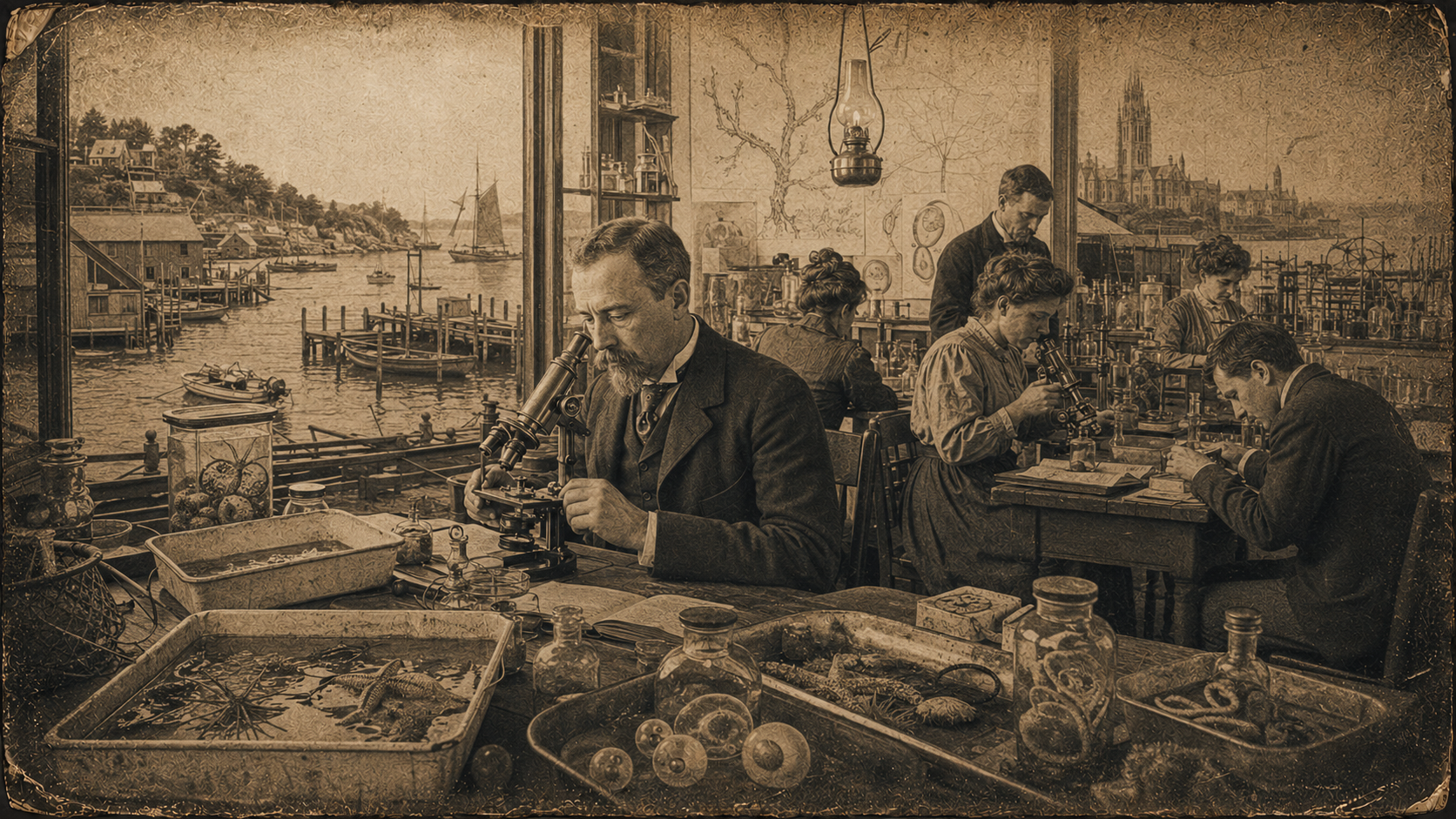
While Charles Crane was bringing the Slavic world into the lecture halls of Chicago, another branch of the family was helping scientists investigate a different kind of hidden machinery. At the southwestern edge of Cape Cod, in the village of Woods Hole, researchers were taking living organisms apart to discover how life constructed itself.
The Marine Biological Laboratory had been founded in 1888 as a place where scientists could work directly with marine life. The ocean provided an enormous living laboratory: transparent embryos, regenerating tissues, unfamiliar organisms and evolutionary relationships that could not be understood from preserved specimens alone. Instead of studying life after it had stopped, Woods Hole allowed researchers to watch it happen.
The Laboratory’s founding director was Charles Otis Whitman, one of the architects of American experimental biology. When the new University of Chicago began assembling its faculty, Whitman became the head of its Department of Zoology. Chicago and Woods Hole were soon connected by a seasonal migration of professors and students carrying questions, specimens and methods between the university and the sea.
Among Whitman’s students was a young Canadian zoologist named Frank Rattray Lillie. Lillie specialized in embryology—the study of how a single fertilized cell becomes a complex living organism. It was one of biology’s most fundamental mysteries. How does a collection of nearly identical cells determine which will become bone, blood, skin, muscle or brain?
In Woods Hole, Lillie met Frances Crane, a daughter of Richard Teller Crane and sister of Charles. They married in 1896. The union connected one of America’s rising biologists to one of Chicago’s largest industrial fortunes. When Lillie returned to the University of Chicago in 1900, science, institutional power and Crane family philanthropy began flowing through the same network.
Lillie succeeded Whitman as head of zoology in Chicago and became the second director of the Marine Biological Laboratory. He was not only a scientist but an institution builder. Under his leadership, Woods Hole developed into an international center where investigators could exchange ideas without the usual boundaries of universities, departments or nations.
The Crane family helped provide the physical machinery. Charles Crane financed the Laboratory’s first permanent research building, dedicated as Crane Laboratory in 1914. He supplied continuing financial support and later helped secure major gifts from the Rockefeller Foundation and the Carnegie Institution. The money generated by valves, pipes and plumbing was now financing microscopes, laboratories and the study of living cells.
The parallel was almost too perfect. Richard Teller Crane had built a fortune by controlling the movement of water, steam and pressure through mechanical systems. At Woods Hole, scientists studied the channels, membranes and developmental processes through which life organized itself. The Cranes had moved from the hidden machinery inside buildings to the hidden machinery inside organisms.
But philanthropy was never simply generosity detached from power. A donor could determine which institution survived, which scholar received a platform and which field of knowledge was allowed to grow. The same method Charles used to support science would also shape his involvement with universities, artists, political movements and foreign governments.
Woods Hole therefore belongs inside the Mucholapka story. It reveals how the Crane network expanded through marriages as well as meetings, laboratories as well as embassies. Chicago supplied the university. Woods Hole supplied the experiments. The family fortune connected them—and Charles learned that carefully placed money could change not merely an institution, but the direction of human knowledge.
This is the question that will follow Crane from the laboratories of Woods Hole to the royal courts of Russia:
When private wealth makes discovery possible, how much power does the benefactor acquire over what the world discovers?
Richard Teller Crane manufactured systems. Frank Lillie studied them. Charles Crane learned how to finance them.