CHAPTER SEVEN: THE OPPOSITE OF WHITE
The White Cross operated through patrons, palaces and public charity. Its authority flowed downward from emperors, grand dukes and civic leaders. In the Balkans, another organization was forming according to the opposite principle. It worked in secret, divided its members into cells and sought not to preserve an imperial system, but to destroy one.
Its official name was Unification or Death. History remembers it as the Black Hand.
The organization emerged from the political violence of Serbia. In 1903, a group of army officers murdered King Alexander and Queen Draga, ending one Serbian dynasty and replacing it with another. Among the conspirators was Dragutin Dimitrijević, better known by his code name, Apis. He survived the attack, advanced through Serbian military intelligence and became one of the most powerful men in the country whom the public had never elected.
In 1908, Austria-Hungary formally annexed Bosnia and Herzegovina, territories it had occupied for thirty years. The annexation enraged Serbia and intensified demands to unite the South Slavic peoples living under Habsburg rule. To Serbian nationalists, Austria-Hungary was not a stable multinational state. It was an empire holding nations inside borders they had not chosen.
The Black Hand was organized in 1911 by Serbian military officers committed to bringing Serb-inhabited territories into a larger national state. Members swore oaths of secrecy and obedience. Its emblem combined a skull, crossed bones, a bomb, a dagger and a vial of poison. The White Cross offered relief to the wounded. The Black Hand prepared men to become wounds in the body of an empire.
But the Black Hand and Young Bosnia were not the same organization. Young Bosnia was a loose revolutionary movement made up primarily of students and intellectuals living under Austro-Hungarian rule. Its members included Serbs, Croats and Muslims who imagined different versions of South Slavic liberation. They were angry, idealistic and young enough to believe that one dramatic act might awaken history.
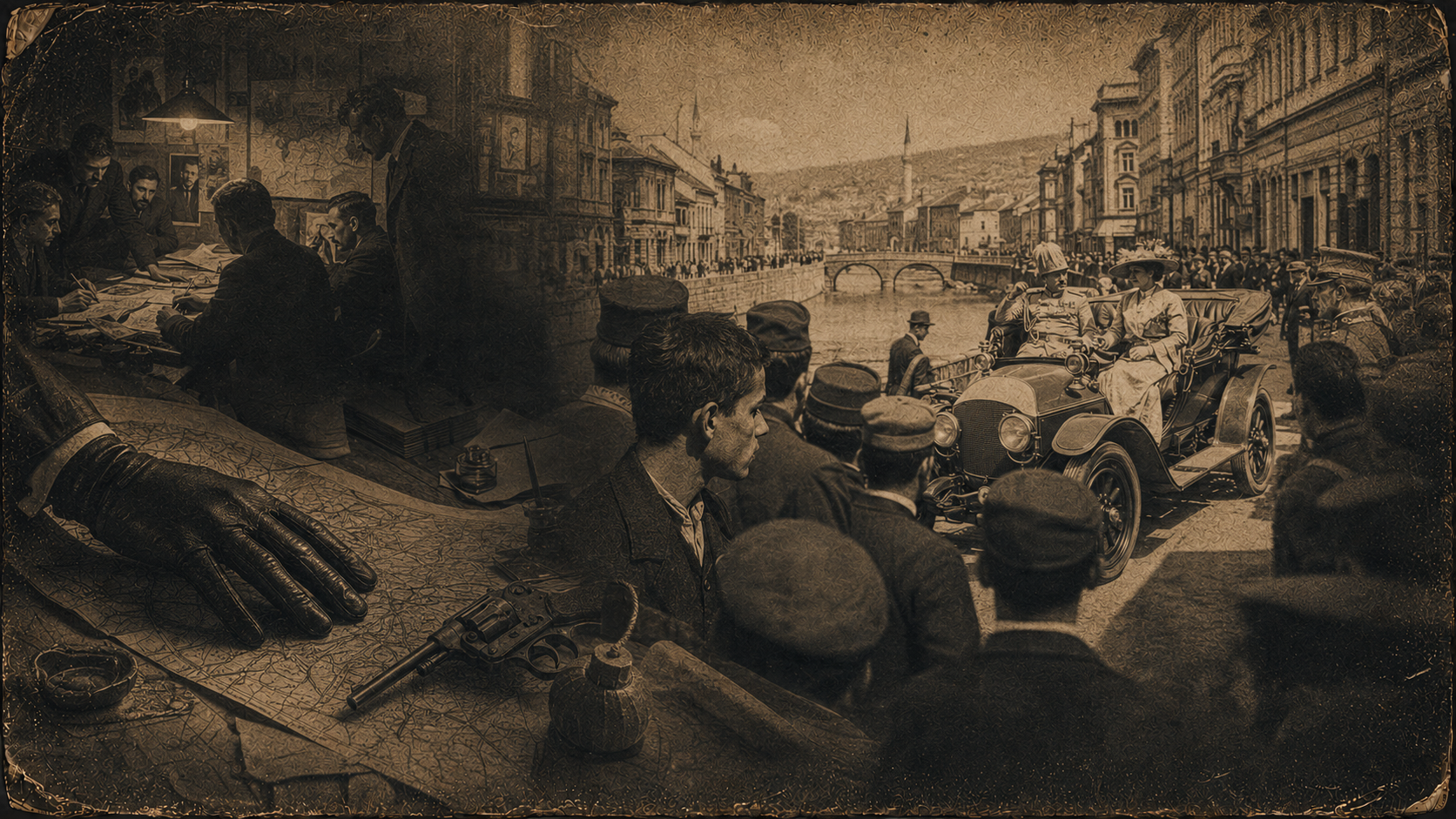
One of them was Gavrilo Princip, a Bosnian Serb barely out of his teens. Princip and his fellow conspirators developed their own desire to strike at the empire, but Black Hand operatives supplied several of them with weapons, training and assistance crossing the border into Bosnia. The young revolutionaries supplied the willingness. Elements of the Serbian underground supplied the machinery.
Their target was Archduke Franz Ferdinand, heir to the Austro-Hungarian throne. His proposed reforms might have granted the empire’s Slavic populations greater political power, which made him dangerous from opposite directions. Hard-line imperialists feared he might weaken the existing order. Serbian nationalists feared he might make that order strong enough to survive.
On June 28, 1914, Franz Ferdinand and his wife, Sophie, traveled through Sarajevo. An assassin threw a bomb and missed. The royal motorcade continued, official plans changed, a driver took a wrong turn and the Archduke’s automobile stopped near the place where Princip happened to be standing. Princip fired twice. Sophie and Franz Ferdinand were dead within minutes.
The assassination did not cause the First World War by itself. Europe had already been divided by military alliances, imperial competition, arms races, ethnic nationalism and governments willing to gamble with millions of lives. Princip struck the match, but the great powers had spent years arranging the powder.
Within five weeks, Austria-Hungary declared war on Serbia. Russia mobilized to defend Serbia. Germany moved in support of Austria-Hungary. France and Britain entered through their own alliances and strategic fears. A conspiracy involving a handful of men had activated a system capable of consuming the world.
The contrast between the white and black networks was not as simple as charity against evil. Both grew from the same collapsing imperial landscape. Both used symbols, oaths, privileged access and personal relationships to operate across national borders. One tried to relieve the suffering produced by power. The other believed suffering was the price of overturning it.
This is the question that will follow us from the streets of Sarajevo into the trenches of the First World War:
How can a handful of conspirators change the world unless the world has already constructed the machinery of its own destruction?
The Black Hand did not build the powder keg. It understood where to place the match.