CHAPTER EIGHT: MEANWHILE, BACK IN THE STATES
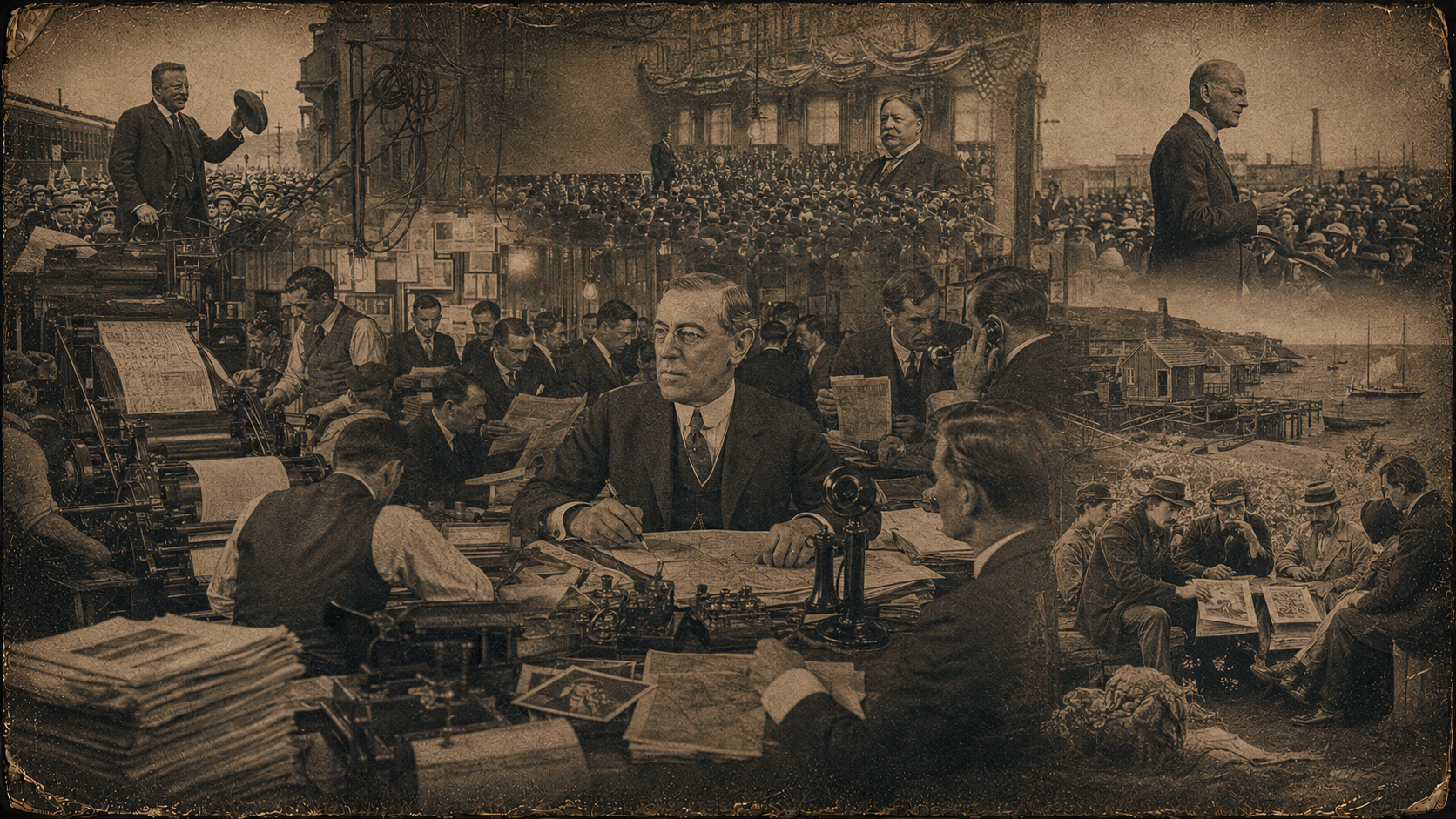
While secret societies and imperial governments maneuvered across Europe, the United States was conducting its own argument about power. Industrial fortunes had transformed the country, but the political system had not caught up with the corporations, banks and private monopolies those fortunes created. Reformers called the new movement Progressivism. They agreed that the machinery required repair, even if they could not agree upon who should control it afterward.
Woodrow Wilson did not emerge from the traditional machinery of national politics. He was a professor of political science, president of Princeton University and, beginning in 1911, governor of New Jersey. He possessed little experience in foreign affairs and had never managed a national campaign. What he did possess was an ability to turn political theory into moral language—and a network of wealthy reformers prepared to make the country listen.
Among them was Charles Richard Crane. Crane had initially supported the progressive Republican Robert La Follette, but shifted his allegiance to Wilson as the reform movement fractured. He became a major financial contributor, fundraiser and political organizer. Alongside figures including Louis Brandeis and Edward House, Crane helped place Wilson inside a coalition of intellectuals, businessmen and reformers who believed government could be rescued from both corporate monopoly and party corruption.
Wilson called his program the New Freedom. He promised to break concentrated economic power, restore competition and return government to ordinary citizens. It was an appealing message from a candidate whose campaign depended upon extraordinary citizens with enough money and influence to distribute it. Crane was no longer simply financing institutions or lecture series. He was helping manufacture a president.
The election of 1912 revealed how divided America had become. The Republican Party split between President William Howard Taft and former president Theodore Roosevelt. Socialist candidate Eugene V. Debs received nearly a million votes. Wilson captured less than forty-two percent of the popular vote but carried forty states. A divided electorate delivered what appeared to be an overwhelming mandate.
Once in office, Wilson lowered tariffs, strengthened antitrust enforcement and signed legislation creating the Federal Reserve System. Its design had roots in the secret 1910 gathering of bankers and government officials at Jekyll Island. Charles Crane belonged to the Jekyll Island Club, but there is no evidence that he participated in that meeting. The distinction matters. Proximity is not proof—but proximity tells us where America’s governing class met, relaxed and exchanged ideas away from public view.
Wilson’s progressivism also contained profound contradictions. His administration expanded federal power while permitting the segregation of federal offices. He spoke of democracy while resisting federal action on women’s suffrage. He condemned concentrated privilege while relying upon private patrons. The moral language surrounding his presidency was often more inclusive than the government operating beneath it.
Another version of America was gathering far from Washington. In Provincetown, writers, labor reporters, feminists, socialists and artists assembled each summer to imagine forms of expression outside the commercial system. Mary Heaton Vorse, John Reed, Susan Glaspell, George Cram Cook, Neith Boyce and their companions turned cottages and a fish house on a wharf into the beginnings of the Provincetown Players.
Many belonged to the same radical world as The Masses, the illustrated magazine edited by Max Eastman. Its pages combined modern art, labor reporting, feminism, satire and revolutionary politics. It challenged the respectable version of progress promoted from the White House. Wilson’s circle believed enlightened leadership could reform the system from above. The Provincetown circle asked whether the system itself had to be rebuilt from below.
When war began in Europe in 1914, these two Americas moved toward collision. Wilson declared neutrality and won reelection in 1916 after a campaign that emphasized keeping the country out of the conflict. The writers around The Masses warned that industrialists, bankers and arms manufacturers were pulling America toward war. Crane, meanwhile, occupied the strange position of supporting a president committed to neutrality while maintaining personal connections throughout Russia, Central Europe and the Balkans.
The same network that helped place Wilson in the White House would soon carry Masaryk and the Czech independence movement to his attention. Crane had helped build the president. Europe was about to determine what that president would be required to become.
This is the question that will follow Wilson from the New Freedom into the First World War:
Can a president created by private networks use public power without becoming accountable to the forces that placed him there?
Charles Crane helped make the candidate. War would make the president.